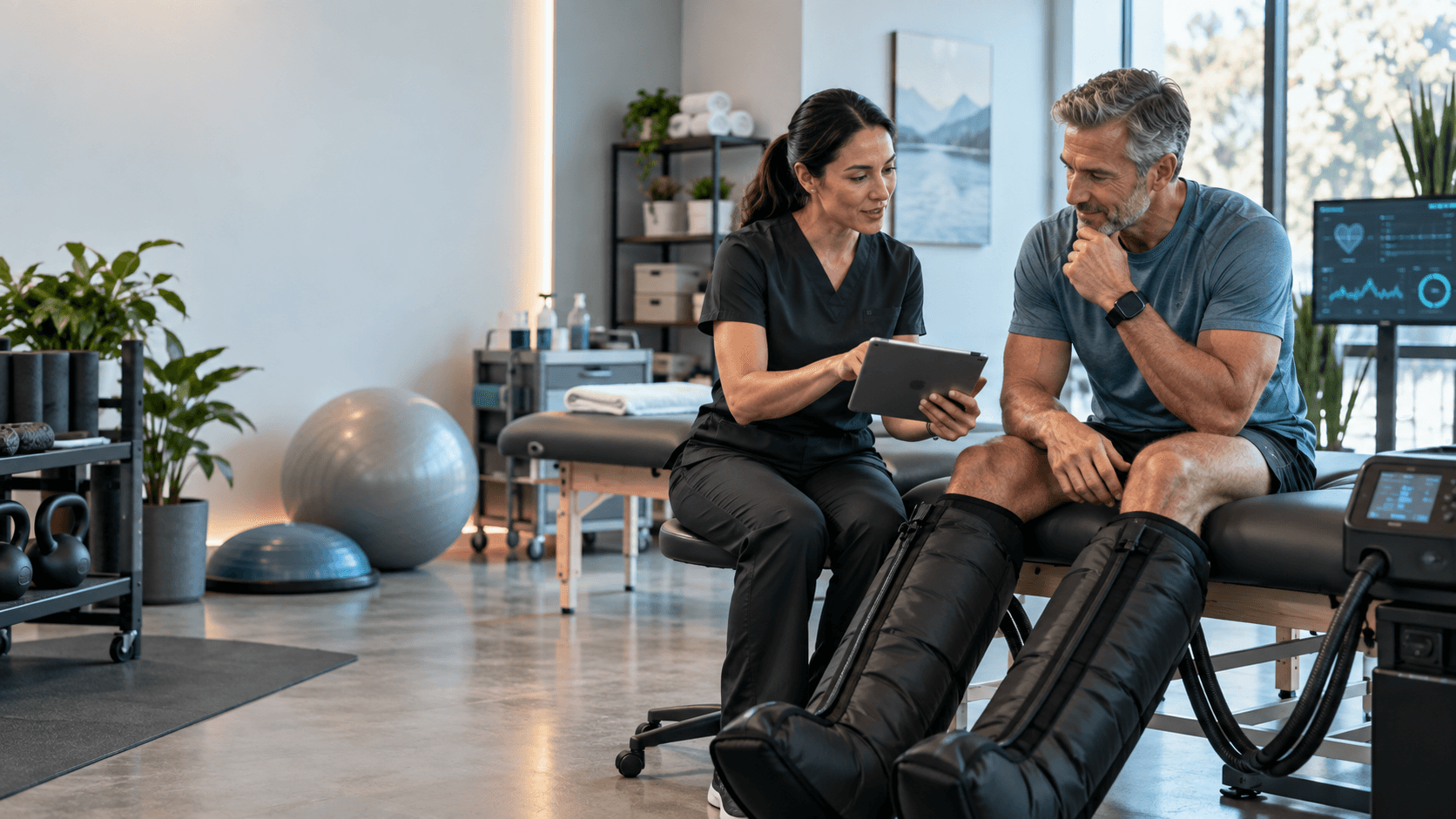
What “good” looks like
A recovery therapy clinic should treat comfort tools as adjuncts, not as a diagnosis. Before compression, cold, percussion, electrical stimulation, float tanks, or heat, someone licensed should ask what happened, when it started, and whether red-flag symptoms are present. That screen includes unexplained one-sided swelling, calf pain after travel, chest pain, fever, numbness, sudden weakness, and postoperative restrictions you cannot recite.
Good care names a functional target. NIAMS materials on sports injuries describe rehabilitation as restoring motion, strength, and return to the activity that caused the problem, not as a sequence of gadgets. A useful clinic writes a baseline you can repeat in two to four weeks: a walk time, stair count, work lift, or sport task. Feeling relaxed after a session is not the same as safer loading.
Infection control belongs with credentials. Shared boots, electrodes, tanks, and tables need a wipe-down protocol you can watch. FDA device pages emphasize labeled use and contraindications. A clinic that cannot name the device model, intended use, or cleaning step is selling atmosphere.
Coordination is the last mark of a serious program. Recovery work should fit a physical therapist, occupational therapist, athletic trainer, surgeon, or primary-care plan when one exists. If you have no diagnosis yet, the honest next step is evaluation, not a membership.
Credentials and scope to verify
Ask who is legally allowed to decide that you are safe to treat today. In most U.S. states, that person is a licensed physical therapist, occupational therapist, athletic trainer, physician, nurse practitioner, or physician assistant. Look the license up on your state board site before you pay for a package.
Titles blur in recovery storefronts. An athletic trainer is not a personal trainer. A massage therapist may hold a state license and still have no authority to clear a concussion, a postoperative joint, or a possible clot. Sharing a suite does not transfer medical decision-making. Ask which license applies to screening, hands-on work, and machine operation.
Device operators need their own limits. Compression, cold, heat, and electrical stimulation have contraindications that include implants, impaired sensation, pregnancy, open wounds, and infection. If the person starting the machine cannot list those limits, or treats a preset name such as recovery or detox as a diagnosis, the clinic is outside a defensible scope.
Ask how the clinic handles overlap with medical and rehabilitation care. A therapist who adds a modality inside a documented plan is different from a spa that tells you to skip therapy because the plunge will handle it. Request who will call your surgeon or therapist if symptoms change. If nobody will make that call, you are buying sessions, not care.
Questions to ask
Bring a short list and expect specific answers. You are shopping for a process, not a vibe. A clinic that answers in slogans is telling you how it sells, not how it practices.
- Who performs the medical or injury screen, and what license do they hold?
- Which symptoms cause you to stop and refer the same day?
- What function will you measure at baseline and at two to four weeks?
- How do you clean shared boots, tanks, electrodes, and tables between clients?
- Will you coordinate with my physical therapist, surgeon, or primary-care clinician if I ask?
- What is the total cost of a time-limited trial, and what is the stop rule if nothing changes?
Ask for the contraindication list for the exact service you are booking. Compression is not appropriate for every swollen limb. Cold is not appropriate for every nerve or vascular problem. NCCIH reviews of massage show even a familiar service has condition-specific evidence and short-term limits. A recovery menu with ten devices should have ten screening paths, not one waiver.
Ask what happens if you worsen. A usable answer names same-day referral for chest pain, sudden swelling, fever, or loss of function. Silence, more of the same protocol, or an upsell to a longer membership is not a safety plan.
Red flags
Walk away from guaranteed healing, detoxification claims, or a single protocol sold for surgery, overtraining, autoimmune disease, and unexplained fatigue alike. Recovery tools are not interchangeable medicines. A clinic that treats every body as a circulation problem is not screening.
Unexplained one-sided swelling, calf tightness after a flight, postoperative redness, or a joint that you cannot bear weight on is not a tightness issue. Those presentations need medical or rehabilitation evaluation. A recovery clinic that wraps, plunges, or compresses first is practicing beyond a wellness role and can delay clot, infection, or fracture care.
Pressure to stop physical therapy, skip imaging your clinician ordered, or replace a home exercise program with daily device time is a hard stop. NIAMS rehabilitation guidance centers on progressive exercise. Devices can sit beside that plan. They should not cancel it. Equally concerning is months of prepaid sessions with no written goal and no exit.
Hygiene shortcuts are easy to see. Cloudy tanks, uncleaned electrodes, and reused linens are infection-control failures. CDC disinfection guidance exists because shared equipment spreads organisms. A scented lobby does not replace that work.
Cost, time, and logistics
Recovery services are often cash-pay even when nearby physical therapy is billed to insurance. Ask for an itemized estimate: intake, each modality, membership, cancellation fees, and any required add-on. A time-limited trial of four to six visits with a written function goal is easier to judge than a year of unlimited plunges. If the clinic will not sell a short trial, you are funding their occupancy, not your progress.
Session length is commonly 20 to 60 minutes. Travel time and the hours you still need for sleep and prescribed exercise belong in the same budget. A clinic that fills every rest day with devices can crowd out the load management that actually changes capacity.
Logistics include who is on site when you feel unwell. Evening rooms may be staffed by technicians only. Confirm that a licensed clinician is available for screening, or that the service is limited to people already cleared. Ask how records are stored and whether body photos are used for marketing.
Before you pay, write the first-month total, the function you will remeasure, and the date you will stop if nothing useful changes. Keep your diagnosing clinician in the loop. Recovery therapy can be a reasonable adjunct when scope, hygiene, and coordination are explicit. It is not a substitute for injury diagnosis.
Frequently Asked Questions
References
NIAMS: Sports Injuries — Diagnosis, Treatment, and Steps to Take
https://www.niams.nih.gov/health-topics/sports-injuries/diagnosis-treatment-and-steps-to-takeFDA: Buying and Using Home-Use Medical Devices Safely
https://www.fda.gov/medical-devices/home-use-devices/buying-and-using-home-use-medical-devices-safelyNCCIH: Massage Therapy — What You Need To Know
https://www.nccih.nih.gov/health/massage-therapy-what-you-need-to-knowCDC: Disinfection and Sterilization
https://www.cdc.gov/infection-control/hcp/disinfection-and-sterilization/index.html Your Privacy Choices