Who this is for
This page is for adults who have been told a fracture is slow to heal, who had a fusion, or who saw PEMF advertised as bone healing. It is also for people comparing a cash-pay mat with a device their surgeon mentioned. Those are not the same offer.
A nonunion means a fracture has not healed in the time your clinician expected. A delayed union is slower than expected but may still heal. Those labels come from exam and imaging, not from a wellness intake. If no one has reviewed films, you do not yet know whether PEMF is even in the conversation.
Prescription bone-growth stimulators are intended, in FDA identification language, as external devices to promote osteogenesis as an adjunct to fracture fixation or spinal fusion, or as treatment for established nonunions or failed fusions. That is a narrow orthopedic lane. It is not a general longevity protocol for “stronger bones.”
This is not first-line care for an acute injury you have not had examined, for an open wound, or for suspected infection. NIAMS materials on sports injuries emphasize evaluation, protection, and indicated treatment. People with osteoporosis still need fall-risk and bone-density care; a mat does not treat those diagnoses.
What options clinics actually offer
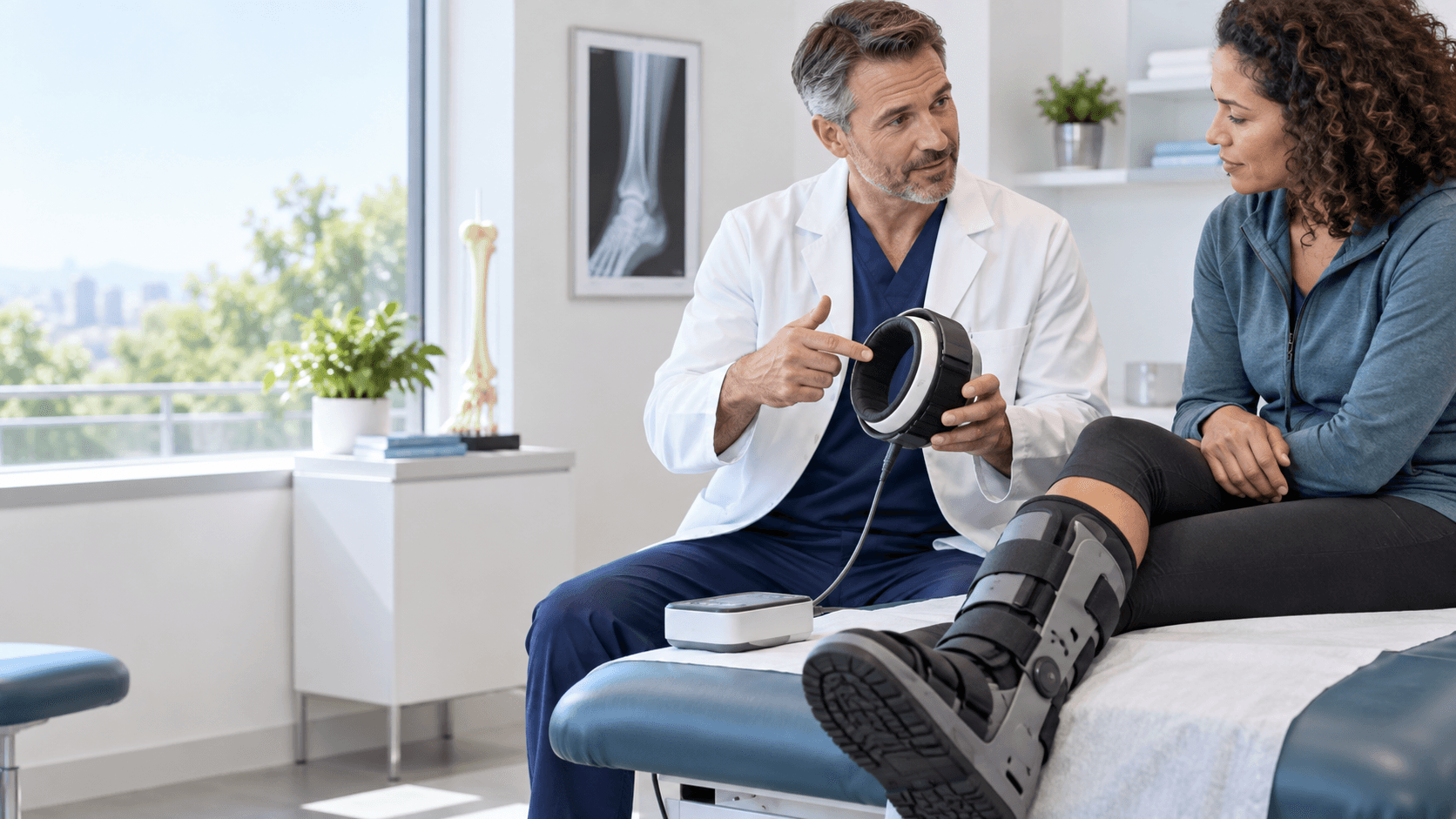
Orthopedic and spine clinics may prescribe a specific stimulator after surgery or after a nonunion diagnosis. The device is chosen for a labeled use, worn on a schedule, and followed with visits. Insurance coverage, when it exists, usually requires documentation of that indication—not a wellness membership.
Longevity and recovery clinics more often sell shared PEMF beds or portable mats for soreness and “recovery.” Staff may mention bone health in the same breath. Unless they are dispensing a prescription stimulator under a treating clinician, they are selling a different product. Ask for the model name and the indication statement.
You may also be offered add-ons: supplements, red light, or hyperbaric sessions stacked onto PEMF. Stacking does not create a union on x-ray. Smoking cessation, nutrition adequate for healing, blood-sugar control, and following weight-bearing instructions usually matter more than a second gadget.
Some people buy consumer PEMF online after reading about orthopedic devices. Home wellness gear is not automatically the coil, intensity, or wear time studied or labeled for nonunion. Using it without orthopedic follow-up can create a false sense that you are already in treatment.
What evidence supports
Cochrane reviewed randomized trials of electromagnetic field stimulation for delayed union or non-union of long bones in adults. Four trials and 125 participants were included, mostly tibial problems. The pooled effect on union was not statistically significant, and the authors said the evidence was inconclusive and insufficient to inform current practice.
That result is easy to misuse in either direction. It does not prove PEMF never helps. It also does not justify promising healing from a spa device. Even the studied stimulators did not produce a clear, practice-changing effect across those small trials. Pain and function were poorly reported.
FDA has long regulated non-invasive bone-growth stimulators as prescription devices. A 2020 FDA presentation and a 2026 Federal Register order describe the device type and, later, reclassification of certain non-invasive stimulators to Class II with special controls. Regulatory history shows a defined orthopedic product—not a general wellness category.
Newer reviews of PEMF for fractures, including a PMC systematic review update, still report mixed protocols and uncertain effects, especially for routine use in acute fractures. Device-specific labeling and your surgeon’s judgment outweigh a clinic’s generic bone-healing slide.
When to see a clinician first
Get urgent care for an obvious deformity, an open fracture, loss of pulses, or numbness after trauma. Those are emergencies. Do not travel to a longevity clinic for PEMF while a bone is unstable. Stabilization and imaging come first.
See an orthopedic clinician if a known fracture is still painful or mobile after the expected interval, if you cannot progress weight bearing as planned, or if a fusion remains painful and limited. Bring prior x-rays. Ask whether the issue is alignment, infection, hardware, biology, or something else.
Infection, poor blood supply, smoking, uncontrolled diabetes, malnutrition, and certain medicines can slow healing. Those need medical management. A magnetic session does not treat osteomyelitis or nicotine use. If a clinic starts with a mat and skips that history, you are in the wrong office.
People with pacemakers or other electronic implants, and people who may be pregnant, should ask the prescribing clinician before any powered electromagnetic device. Product labels differ. “Bone healing PEMF is gentle” is not an implant clearance.
How to judge progress
Union is judged by your clinician using exam and imaging, on a timeline that matches the bone and the surgery. That is the outcome that matters. A membership punch card is not a healing score.
Function is the second measure: walking distance, ability to bear weight as allowed, pain at rest versus activity, and return to agreed tasks. Track those in writing. If function stalls, call the orthopedic office rather than adding a second wellness modality.
Do not use sensation during PEMF as a marker. Many devices produce little feeling. Do not use “I slept better after the mat” as proof the fracture is closing. Sleep can improve for many reasons and can worsen if you are under-treating pain or overusing the limb.
Set a review date when a stimulator is prescribed. Ask what finding would stop the device or lead to surgery. If you are only using a wellness mat, set an even shorter personal stop date and keep the orthopedic appointment. Healing claims without films are advertising.
Frequently Asked Questions
References
Cochrane: Electromagnetic field stimulation for delayed union or non-union
https://www.cochrane.org/evidence/CD008471_does-electromagnetic-field-stimulation-help-heal-fractures-are-failing-or-have-failed-healPMC: Cochrane review of electromagnetic field stimulation for long-bone non-union
https://pmc.ncbi.nlm.nih.gov/articles/PMC12754039/Federal Register: Reclassification of Non-Invasive Bone Growth Stimulators
https://www.federalregister.gov/documents/2026/04/16/2026-07366/physical-medicine-devices-reclassification-of-non-invasive-bone-growth-stimulatorsFDA presentation: Proposed reclassification of non-invasive bone growth stimulators
https://www.fda.gov/media/141902/downloadNIAMS: Sports Injuries
https://www.niams.nih.gov/health-topics/sports-injuries Your Privacy Choices