What you are comparing
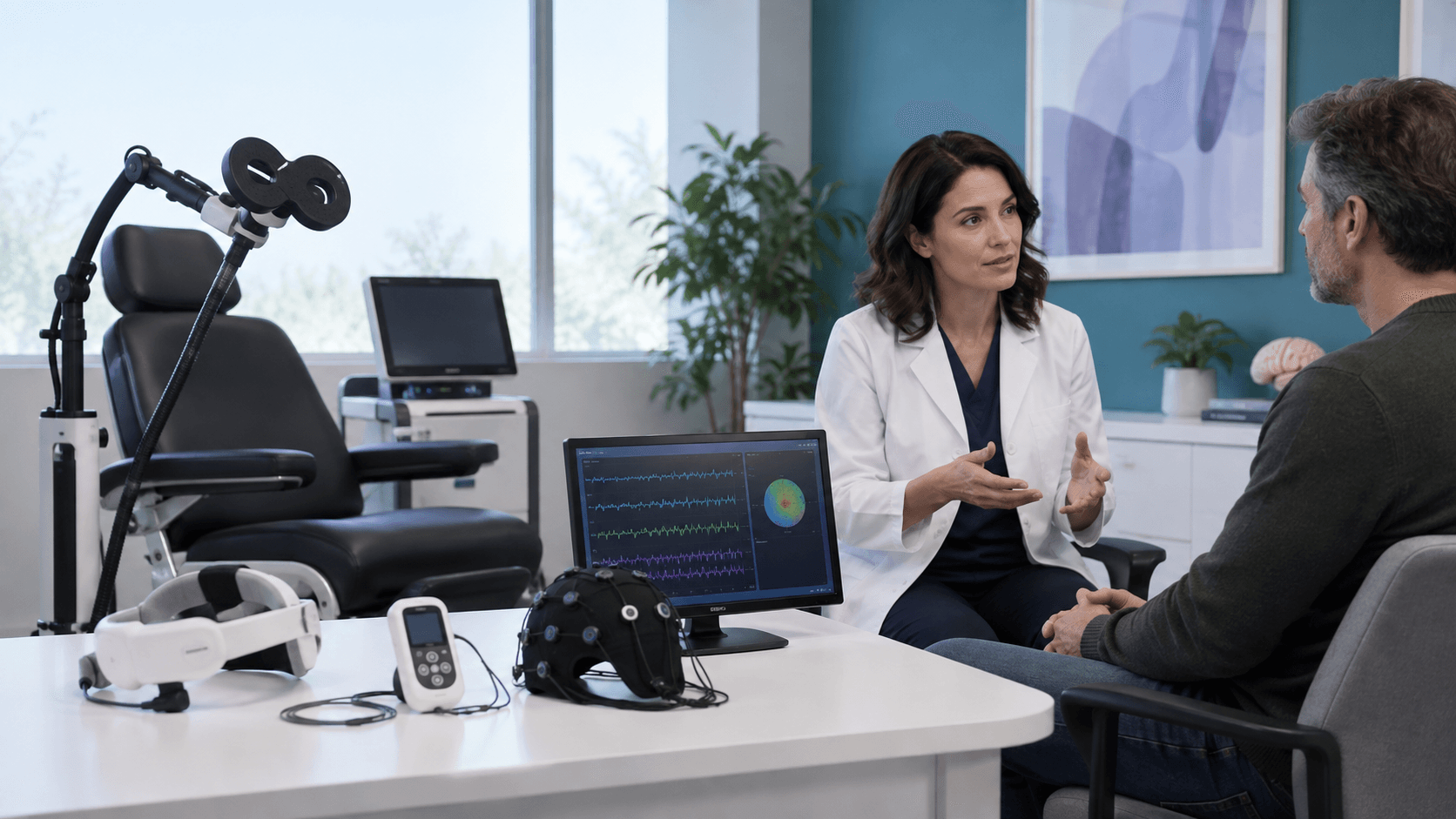
These four names get bundled on longevity menus as “brain optimization.” They are not one therapy. TMS uses a clinic coil to deliver pulsed magnetic fields that induce current in a targeted cortical region. CES applies low electrical current through ear-clip or scalp electrodes. tDCS applies weak direct current between scalp electrodes. Neurofeedback records EEG and trains you with audio or visual feedback; it does not push current into the brain.
U.S. regulation follows the device and the intended use, not the hallway brand. NIMH describes some stimulation methods as FDA-authorized for specific mental disorders and others as newer or experimental. A headset sold for focus is not automatically in the authorized group. Clearance or classification for one product does not transfer to another montage or app.
Clinic TMS for depression is typically prescription care with screening, motor-threshold work, and a defined course. CES and many tDCS systems appear in cash clinics or as consumer kits. Neurofeedback may be offered by psychologists, coaches, or technicians with uneven training. The person holding the device matters as much as the acronym.
You are not choosing a lifestyle upgrade. You are choosing whether a labeled psychiatric treatment, a lower-evidence electrical product, or a feedback training program fits a diagnosis you actually have. If no one has made that diagnosis, comparison shopping among gadgets is premature.
How they differ
Energy and targeting differ first. TMS fields are strong enough to depolarize cortical neurons in a focal volume. CES and tDCS use much weaker currents with broader, montage-dependent paths. Neurofeedback measures brain electrical activity and asks you to change a signal. Calling all four “stimulation” hides those mechanics.
Indications differ next. Certain TMS systems are cleared for major depressive disorder in people who have not responded adequately to antidepressant medicine, and some have additional labeled uses such as adjunctive obsessive-compulsive disorder. PMC reviews of FDA milestones show those uses accumulated device by device. CES has its own classification history and device-specific labeling. Consumer tDCS often has no psychiatric indication at all.
Evidence strength follows those labels. TMS for treatment-resistant depression has a clinical literature and practice infrastructure that CES, tDCS, and neurofeedback do not match for the same claims. NCCIH notes mixed ADHD results for neurofeedback. Research-grade tDCS protocols in laboratories are not the same as a storefront headset with a wellness app.
Risk and oversight differ last. TMS can cause scalp discomfort and, rarely, seizure; clinics should screen metal, seizure history, and hearing protection. Electrical devices have skin, implant, and dosing issues. Neurofeedback is low-current but can delay indicated care if it is sold as a stand-alone diagnosis. A longevity add-on visit is not equivalent to a psychiatry-supervised TMS course.
Who each option is for
Clinic TMS is for people with a documented psychiatric indication that matches the device label, usually after medicine has been inadequate or poorly tolerated, under a physician-led program. It is not a drop-in focus session for executives who want a cognitive edge. Suicidal thinking, bipolar screening, and medicine changes still need a psychiatrist or other licensed prescriber.
CES may be discussed for device-specific labeled symptoms such as certain anxiety or insomnia claims, depending on the product. The evidence bar is lower and more mixed than for depression TMS. It is a poor fit if you have not had a basic mental-health evaluation, or if you hope a ear-clip current will replace therapy and medicine you already need.
tDCS is mainly a research and wellness category in clinic storefronts. Some trials explore depression, pain, or performance, with mixed methods. A reasonable use is a supervised research protocol or a cautious, time-limited adjunct after a clinician explains uncertainty. It is not for people who think a consumer kit is “TMS at home.”
Neurofeedback may interest families exploring non-drug ADHD supports, or adults curious about attention training, if a licensed clinician still owns diagnosis. NCCIH and ADHD science summaries do not treat EEG training as equivalent to established ADHD care. Skip it if the seller diagnoses you from a colorful brain map alone.
Risks of choosing the wrong one
The main harm is delay. Depression, panic, psychosis, and cognitive change can come from medical illness, substances, or a primary psychiatric disorder. NIMH depression pages put evaluation and indicated treatment first. Weeks spent on a wellness headset can postpone medicine, psychotherapy, or TMS that actually matches the diagnosis.
Safety is the second harm. TMS has rare seizure risk and implant contraindications. Electrical devices can irritate skin or interact with implanted stimulators. Home tDCS montages are easy to misplace. A clinic that never asks about metal in the head, seizure history, or pregnancy is not practicing device medicine.
Financial substitution is the third. A long neurofeedback or CES package can cost as much as a portion of indicated care while producing only a comfort ritual. If function, sleep, or suicidal thinking is worsening, extra sessions are not a titration plan. Ask who you call after hours before you pay.
Mislabeling is the fourth. Staff may say “this is like TMS” because both involve the head. That sentence is false. Magnetic clinic protocols, weak direct current, ear-clip CES, and EEG games are different products. Believing the slogan can lead you to refuse a referred TMS evaluation you actually qualify for.
How to decide
Start with a licensed diagnosis. A psychiatrist, neurologist, or other qualified clinician should name the condition, review medicines, and say whether any device has a matching indication. If the answer is clinic TMS, ask about the system, the labeled use, session number, and how mood will be scored. That is a treatment decision, not a spa add-on.
If the offer is CES, tDCS, or neurofeedback, ask for the exact device, any FDA classification or clearance letter, and the indication sentence. Compare that sentence with your diagnosis. If they do not match, you are buying an off-label or wellness experiment. Decide whether a short, measured trial is worth the cost and the delay risk.
Keep crisis rules ordinary. Sudden suicidal thinking, mania, psychosis, seizure, or stroke symptoms are emergency problems. No headset setting treats them. Tell the clinic you will keep your existing mental-health clinician, and that records should be shared. A program that isolates you from that clinician is a warning sign.
Choose the smallest reversible step. Pay for a defined TMS consultation or a short adjunct trial with one function measure, not a year of “optimization.” If staff cannot explain how TMS differs from a consumer device, walk away. The accurate comparison is labeled clinic care versus mixed-evidence gadgets—not four equal brain upgrades.
Frequently Asked Questions
References
NIMH: Brain Stimulation Therapies
https://www.nimh.nih.gov/health/topics/brain-stimulation-therapies/brain-stimulation-therapiesNIMH: Depression
https://www.nimh.nih.gov/health/topics/depressionPMC: FDA Milestones for TMS Devices
https://pmc.ncbi.nlm.nih.gov/articles/PMC8864803/NCCIH: ADHD and Complementary Health Approaches
https://www.nccih.nih.gov/health/providers/digest/adhd-and-complementary-health-approaches-science21 CFR 882.5800—Cranial Electrotherapy Stimulator
https://www.ecfr.gov/current/title-21/section-882.5800 Your Privacy Choices