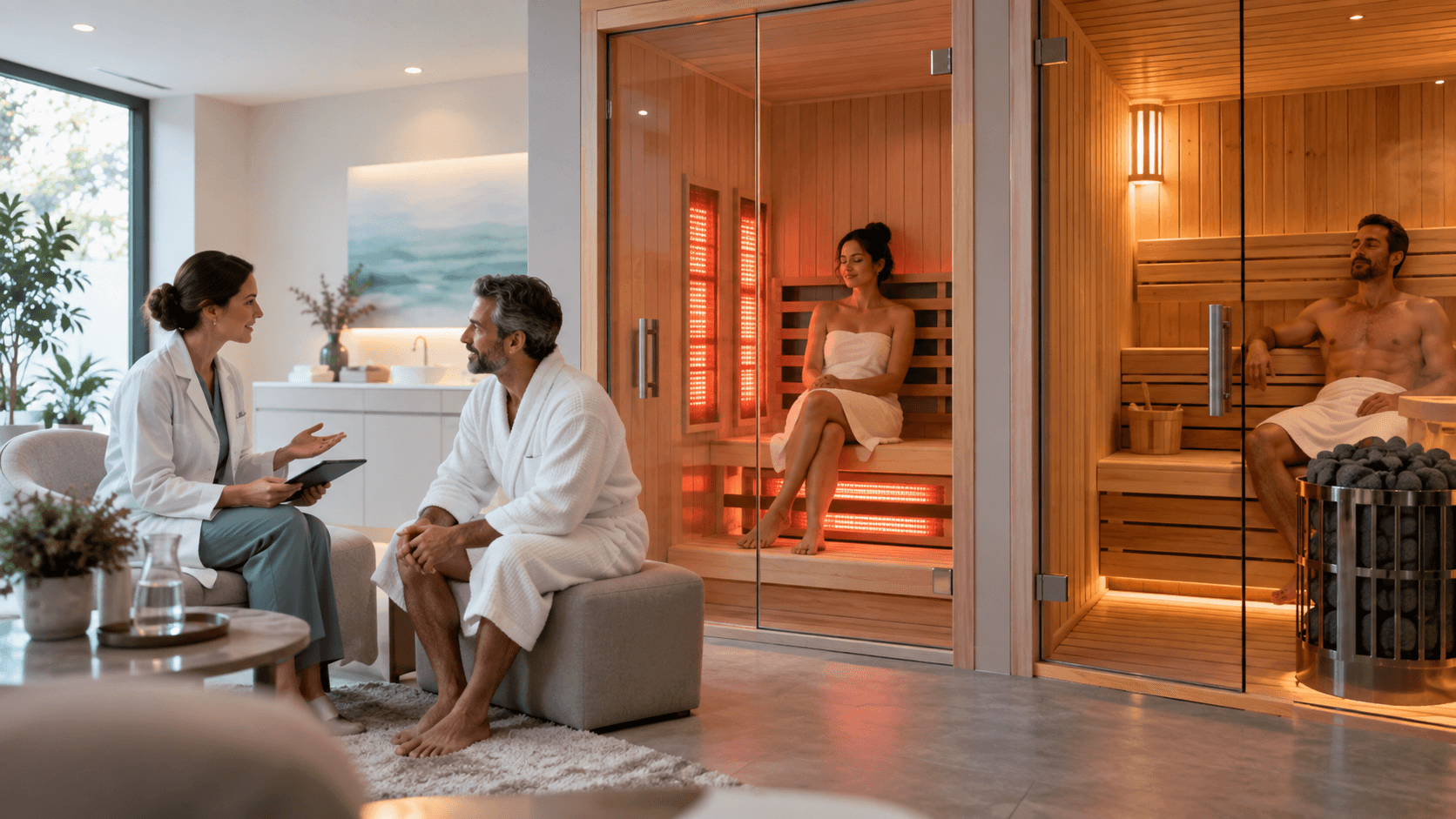
What you are comparing
A traditional Finnish sauna is a hot, relatively dry room, typically about 80 to 100°C (176 to 212°F), with humidity often in the 10 to 20 percent range unless water is thrown on rocks. Sessions are usually short—about 5 to 20 minutes—with cool-down breaks. A PMC systematic review of dry sauna bathing uses that profile as the most studied form of whole-body thermotherapy.
An infrared sauna uses emitters (near, mid, or far infrared) to warm skin and superficial tissue. Cabin air is cooler, often cited around 45 to 60°C (113 to 140°F), for a similar sitting time. Japanese Waon protocols in research used about 15 minutes at 60°C far infrared, then a wrapped recovery period to keep core temperature up. Infrared heat is not a milder medical category. It is a different delivery of heat load.
Both raise heart rate, widen skin blood vessels, and can increase core temperature. Both are sold as recovery, “detox,” or conditioning. Neither replaces blood-pressure treatment, cardiac rehab, or emergency care for chest pain. The American Heart Association states that heat forces the heart to work harder as vessels expand and heart rate rises. That applies in a 90°C room and in a cooler infrared box if core temperature climbs.
This comparison is for adults choosing a cabin style. It is not a protocol for unstable angina, decompensated heart failure, pregnancy, or alcohol intoxication. If a clinician told you to avoid moderate exercise, discuss unsupervised sauna first.
How they differ
Air temperature and humidity are the obvious split. Traditional rooms feel harsher on the airway and skin. Infrared rooms feel more tolerable to many first-time users because the air is cooler, even when emitters are heating tissue. A PMC heat-therapy review notes that esophageal temperature can rise about 1.5°C within 10 minutes in a traditional sauna, while Waon-style infrared has been reported to raise core temperature about 1.0 to 1.2°C in 15 minutes, then hold that rise during blanket recovery. Those are research conditions, not a guarantee of what your spa timer produces.
Humidity and water-on-rocks change the traditional experience. A sudden steam burst increases heat strain. Infrared cabins typically add no steam. Cooling rituals differ too. AHA specifically warns people with high blood pressure not to bounce between cold water and hot tubs or saunas, because that contrast can raise blood pressure. Alcohol in either cabin is a poor mix.
Evidence bases are not twins. Frequent Finnish sauna use in observational cohorts has been associated with lower cardiovascular mortality. Those users may also differ in activity, smoking, and social patterns. Randomized infrared studies include small heart-failure Waon trials with mixed methods quality; a dry-sauna review found that only one of several cardiovascular RCTs met a low-bias Cochrane bar. “Sauna for longevity” is not an outcome both cabins have proven in large U.S. trials.
Detox marketing is similar and similarly weak. NCCIH lists saunas among detox and cleanse approaches and describes limited clinical evidence that those programs do what ads claim. Sweat is not a validated method for clearing environmental chemicals in wellness clients. The liver and kidneys remain the organs that handle waste. FDA and FTC have acted against detox products that hid ingredients or promised to treat disease—another reason a “toxin panel plus infrared” bundle should not replace licensed care.
- Traditional: hotter air, faster perceived strain, more Finnish observational data.
- Infrared: cooler air, emitter heating, some Waon research, not automatically safer.
- Both: heart-rate rise, dehydration risk, heat-illness risk, weak detox evidence.
Who each option is for
A traditional sauna may fit adults who already tolerate dry heat, can sit and stand without dizziness, and will take cool-down breaks. It is a poor first pick if you have poorly controlled hypertension, recent cardiac events, or you faint easily in heat. People who enjoy contrast plunges should read AHA’s warning about alternating hot and cold.
An infrared cabin may fit people who find 90°C air intolerable but still want passive heat, or who are using a supervised protocol a cardiology team actually prescribed. It is not a loophole for someone told to avoid heat or moderate exercise. Cooler air can hide how high core temperature has climbed if you sit longer “because it feels easy.”
Neither cabin is for children left unsupervised, people who are drinking, or anyone with confusion, vomiting, or chest pain. Pregnancy needs an obstetric conversation; passive heat is not a casual add-on. Older adults and people on diuretics, beta blockers, ACE inhibitors, or other blood-pressure drugs can have exaggerated heat responses, as AHA heat advisories note for environmental heat. The same caution applies inside a box.
Risks of choosing the wrong one
Choosing traditional heat because a blog said it “sweats more toxins” can mean a faster, less comfortable strain without a detox payoff. Choosing infrared because it is “gentle” can mean a longer sit, more dehydration, and the same cardiac load. Heat exhaustion and heat stroke are clinical emergencies in either setting. Confusion, fainting, and cessation of sweating are not a wellness afterglow.
Using either sauna instead of treating coronary disease is the larger error. Observational associations are not a reason to skip indicated medicine, smoking cessation, or rehab. Unstable symptoms belong in urgent care, not a cabin. Alcohol plus heat raises arrhythmia and injury risk.
Clinic packages that bolt sauna to unapproved chelation or colonics stack weak detox claims. NCCIH separates medical chelation for selected metal poisoning from wellness cleanses. Do not let a heat session justify those extras.
How to decide
Name the goal: relaxation, a heat you already enjoy, or a clinician-directed protocol. Ask what temperature, humidity, and time the facility uses and whether staff will help you exit if you feel unwell. Ask how they screen for heart disease, pregnancy, and alcohol. AHA guidance on saunas and controlled hypertension is a better script than a longevity menu.
Hydrate before and after. Skip alcohol. Sit near the door on the first visits. Stop for dizziness, nausea, chest pain, or confusion. If you have heart failure, recent infarction, or uncontrolled blood pressure, get a physician, NP, or PA opinion before buying a membership.
Do not buy toxin scores as proof the cabin worked. Judge the session by whether you cooled safely and still take cardiovascular care that has outcome data. Heat is a load. Choose the load you can supervise, not a brand that promises to purify you.
Frequently Asked Questions
References
AHA: Getting active to control high blood pressure (hot tubs and saunas)
https://www.heart.org/en/health-topics/high-blood-pressure/changes-you-can-make-to-manage-high-blood-pressure/getting-active-to-control-high-blood-pressureAHA: Extreme heat is rising — and so is the risk to your heart
https://newsroom.heart.org/news/extreme-heat-is-rising-and-so-is-the-risk-to-your-heartNCCIH: “Detoxes” and “Cleanses”: What You Need To Know
https://www.nccih.nih.gov/health/detoxes-and-cleanses-what-you-need-to-knowPMC: Clinical effects of regular dry sauna bathing (systematic review)
https://pmc.ncbi.nlm.nih.gov/articles/PMC5941775/PMC: Heat therapy: mechanistic underpinnings and cardiovascular applications
https://pmc.ncbi.nlm.nih.gov/articles/PMC8285605/ Your Privacy Choices