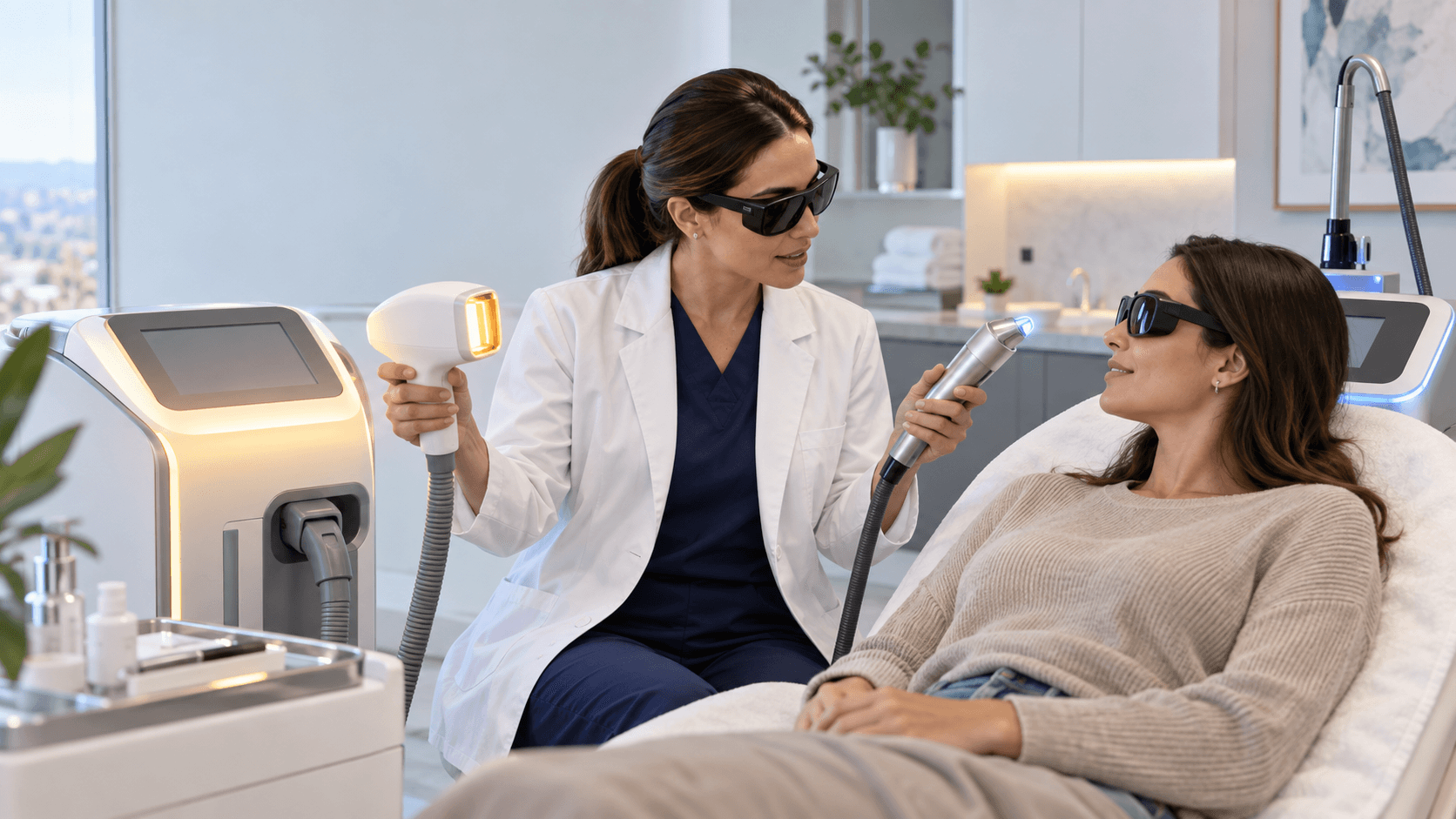
What you are comparing
Laser treatment uses a single wavelength, or a very narrow band, aimed at a chromophore: melanin, hemoglobin, or water. Pulse width, spot size, and fluence are chosen so energy prefers that target. FDA regulates medical lasers as radiation-emitting products and as devices. Class labeling exists because a misaimed beam can injure eyes and skin. AAD pages discuss lasers for sun damage, redness, and selected rosacea vessels when a dermatologist builds a plan.
Intense pulsed light (IPL) is not a laser. It is a filtered flashlamp that emits a broad band of wavelengths. Cutoff filters try to favor pigment or vessels, but multiple wavelengths still hit the skin. That is why IPL is marketed for mixed photodamage—brown spots plus redness—in one pass. It is also why pigment safety is less tidy than a well-chosen single-wavelength laser, especially in darker phototypes.
Clinics sell both as “photofacials.” The useful comparison is specificity, phototype, eye protection, and whether anyone examined the spots as possible skin cancer. AAD sun-damage guidance lists IPL and laser resurfacing among options after a dermatologist evaluates the skin. The same pages note that dermatologists check for skin cancer before treating what looks like an age spot.
This comparison is for adults considering light or laser for sun spots, redness, or texture. It is not a melanoma treatment. Changing, itching, or bleeding lesions need a medical exam. CDC and AAD treat new or changing spots as a reason to see a clinician, not a reason to book a flash.
How they differ
Wavelength control is the physics split. A laser can be selected for hemoglobin, pigment, or water. IPL delivers a spectrum. Filters narrow it, but they do not create monochromatic precision. For discrete vessels, AAD rosacea materials discuss laser or light as an adjunct to medical therapy, not a cure-all.
Pigment risk differs by phototype. Reviews of cosmetic devices in Fitzpatrick IV to VI often treat IPL as higher risk or limited evidence in the darkest types because melanin competes for the broad band. Burns, PIH, and hypopigmentation are the feared outcomes. Some lasers (for example, longer-wavelength devices chosen by experts) are preferred for selected indications in darker skin. A “one IPL setting for all” protocol is a red flag.
Eye safety is nonnegotiable for both. Laser classes exist because retinal injury is a known industrial and medical hazard. IPL goggles are still required; the flash is intense. Periocular work needs corneal shields when indicated. Do not close your eyes and hope. FDA laser-product rules exist whether the clinic calls it a facial or a procedure.
Downtime and indication also differ. IPL often means a few days of darkening of spots, then flake. Vascular lasers can leave purpura. Ablative lasers are a different category with wound care. Mixing those expectations is how people book a lunch-hour IPL and get a resurfacing recovery—or the reverse, and then complain that “light does nothing.”
- Laser: specific wavelength, indication-driven, class-labeled eye hazard.
- IPL: broad band, mixed photodamage in selected lighter phototypes.
- Both: not a biopsy, not a substitute for mole checks.
- Darker skin: more planning, sometimes avoid IPL entirely.
Who each option is for
IPL may fit a lighter-skinned adult with mixed redness and lentigines, no suspicious lesions, and a clinician who will adjust filters and fluence and insist on sun avoidance. It is a poor fit for a recent tan, Fitzpatrick V to VI in many practices, or anyone who wants a laser-precise vessel treatment. It is also a poor fit if the “spots” have not been examined.
A specific laser may fit discrete telangiectasias, selected pigmented lesions already judged benign, or resurfacing goals that IPL cannot meet. AAD rosacea pages note that laser or light may reduce visible vessels but is rarely the only therapy. Ablative resurfacing is a wound, not a glow. Match the laser to the diagnosis.
People with photosensitizing medicines, active herpes in the field, or a history of PIH need a licensed clinician to say wait or modify. Pregnancy often means deferral of elective light. Gold therapy, isotretinoin timing, and seizure history with flashing lights are individual questions—ask, do not hide them.
Everyone with a changing lesion needs a skin exam first. AAD states that dermatologists check for cancer before treating sun damage. CDC materials emphasize that skin cancer is common and that changing spots deserve evaluation. Light on an undiagnosed melanoma is a delay, not a treatment.
Risks of choosing the wrong one
Using IPL on darker skin or a tan can cause burns and lasting pigment change. Using a pigment laser on a lesion that was actually a melanoma can delay oncology care and, in some techniques, complicate later assessment. Using either device without eye protection can injure vision. Those are not theoretical spa stories; they are why training and shields exist.
Choosing IPL when you needed a vascular laser can mean extra heat in pigment with incomplete vessel clearance. Choosing aggressive laser when you needed gentle IPL or topical care can mean weeks of downtime for a problem that did not require a wound.
The quiet harm is skipped cancer surveillance. A brighter cheek does not cancel the need to watch the back, scalp, or a changing nevus. AAD comments on screening still tell the public to see a dermatologist for new, different, itching, or bleeding spots. Do not let a photofacial package replace that visit.
Unlicensed operators and unnamed devices add risk. If the clinic cannot say IPL versus laser, wavelength or filter, and who is licensed, you cannot consent.
How to decide
Get the spots examined. If any lesion is atypical, biopsy or dermoscopic follow-up comes before cosmetic light. Then name the target: vessels, lentigines, texture, or mixed photodamage. Ask which device and why that is safer for your Fitzpatrick type than the alternative.
Ask about eye shields, expected purpura or crusting, antiviral prophylaxis if you get cold sores, and after-hours burn care. Ask how many days you must avoid sun and heat. If you cannot do the aftercare, do not do the pass.
Price a series only after a test spot if your pigment risk is high. Set a stop rule when PIH appears. Do not “push through” a burn. Photographs in the same light beat a filtered selfie.
Keep sunscreen, self-exams, and indicated dermatology follow-up. Use IPL or laser as optional repair of photodamage after the medical question is answered. A photofacial is not a skin-cancer exam, and a laser is not a broader light band with a fancier name.
Frequently Asked Questions
References
AAD: How dermatologists treat sun-damaged skin
https://www.aad.org/public/everyday-care/sun-protection/sun-damage-skin/wrinkles-sun-damage-can-be-treatedAAD: Lasers and lights for rosacea
https://www.aad.org/public/diseases/rosacea/treatment/lasers-lightsAAD: Statement on skin cancer screening
https://www.aad.org/news/aad-statement-uspstf-cancer-screeeningFDA: Laser Products and Instruments
https://www.fda.gov/radiation-emitting-products/home-business-and-entertainment-products/laser-products-and-instrumentsCDC: Skin Cancer
https://www.cdc.gov/skin-cancer/about/index.html Your Privacy Choices