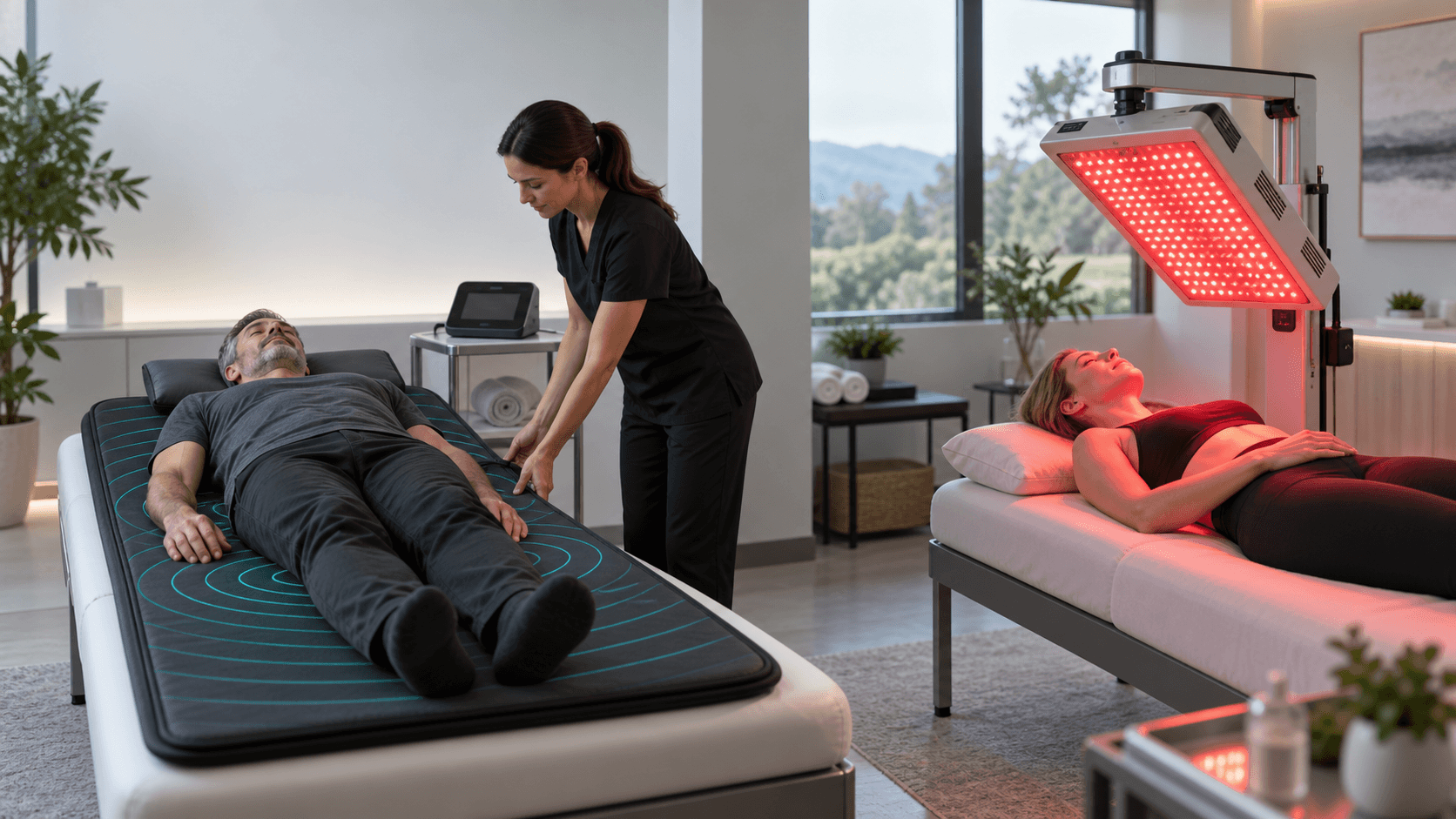
What you are comparing
PEMF and red light therapy are often sold in the same recovery room. They are not the same energy and they do not share one evidence file. PEMF uses pulsed electromagnetic fields from a coil or mat. Red light therapy, also called photobiomodulation or low-level light therapy, uses red or near-infrared light from LEDs or lasers.
Clinics bundle them because both are noninvasive, cash-pay, and easy to schedule. That convenience is not a reason to treat them as interchangeable. A useful comparison is mechanism, typical indications studied, device class, and whether anyone has examined you for a diagnosis that actually needs treatment.
FDA status also splits. Some therapeutic lasers and LED systems have 510(k) clearances for named uses such as selected pain or cosmetic indications. Some PEMF products are prescription orthopedic stimulators. Many consumer mats and panels are sold with wellness language. Clearance for one product does not transfer to the other modality.
Neither option replaces a diagnosis. Joint swelling, night pain, neurologic weakness, a wound that will not close, or depression are clinical problems. Light and magnetic sessions can be adjuncts after a plan exists. They are a poor first step when you do not yet know what you are treating.
How they differ
The physics differ. PEMF aims to induce small electrical effects in tissue with a changing magnetic field. Photobiomodulation delivers photons that are absorbed by chromophores; proposed effects include local photochemical changes. Those mechanisms are studied in different papers, with different doses. You cannot convert a mat setting into a wavelength or the reverse.
Evidence differs by condition. NCCIH notes that some low-level laser research for low-back pain suggests possible benefit in limited settings, and that the American College of Physicians has included low-level laser as an option for chronic low-back pain based on low-quality evidence. That is not a finding about PEMF mats, and it is not a finding about anti-aging panels.
NCCIH’s magnet page treats static magnets and electromagnetic therapy as separate questions and states that research on static magnets for pain is extremely limited. Electromagnetic studies that exist are not automatically studies of the shared bed in a longevity clinic. Device, dose, and diagnosis have to match.
Safety and practical use differ too. Light devices raise questions about eye exposure, photosensitizing drugs, and skin. Magnetic devices raise questions about implanted electronics and metal. Session time, contact with skin, and whether a licensed person screens you should change with the hardware—not with a membership name that says “recovery suite.”
Who each option is for
A labeled photobiomodulation or low-level laser device may be reasonable as an adjunct for a person whose clinician has already evaluated musculoskeletal pain and wants a time-limited trial alongside exercise, weight-bearing as allowed, and usual pain care. It is a weaker fit when the pitch is that a panel will reverse aging or replace medical evaluation.
A prescription PEMF bone-growth stimulator is for a person with a defined orthopedic indication under a surgeon or treating clinician—not for general wellness. Consumer PEMF for soreness is an optional comfort measure at most. People with pacemakers or other implanted electronic devices need product-specific advice before either magnetic or some electrical devices.
People with inflammatory arthritis, suspected infection, cancer-related pain, or a fracture that is not healing need specialty care first. NIAMS materials on osteoarthritis and bone health emphasize evaluation and established treatments. A light or magnet package is not a substitute for those pathways.
Pregnant people, people on photosensitizing medicines, and people with active skin disease over the treatment site should ask a licensed clinician before light therapy. People with implants should ask before PEMF. If the clinic cannot screen those issues, neither option is a good first purchase.
Risks of choosing the wrong one
The main harm is delay. Spending weeks in a lighted bed or on a mat can postpone imaging for a nonunion, a steroid-sparing plan for inflammatory disease, or physical therapy that has a clearer functional target. Time in a recovery suite is still time.
A second harm is false equivalence. You may assume a red-light clearance for wrinkles or a PEMF clearance for a bone stimulator applies to your knee or your sleep. FDA clearance does not travel across indications. Buying the wrong category wastes money and creates misplaced confidence.
Device-specific harms still exist. Light can irritate skin or pose eye risk if used carelessly. Magnetic fields can be contraindicated with some implants. Stacking both in one hour does not cancel those issues. “Noninvasive” is not the same as “no screening required.”
Marketing stacks also hide missing outcomes. If the clinic cannot say whether the goal is pain during activity, wound appearance, or sleep, you cannot tell whether the wrong modality was chosen. Vague optimization language makes it easy to keep paying after nothing measurable has changed.
How to decide
Start with the diagnosis, not the device menu. See a physician, nurse practitioner, physician assistant, or physical therapist for pain, wounds, or function limits that are new, severe, or unexplained. Ask whether any device is an adjunct and which outcome will be checked in four to six weeks.
If you still want a trial, match the device to a labeled use. Ask for the 510(k) number and indication statement. Compare PEMF and light as separate purchases. Do not accept “we do both, so it covers everything” as a clinical rationale.
Price a short course, not a year-long membership, until you know whether anything changed. Keep exercise, sleep, and indicated medicines in place. A device that requires you to stop physical therapy or skip an orthopedic visit is the wrong device for that month.
Stop if you have implant concerns the staff cannot answer, if pain is worsening, or if the only progress report is that the session felt warm or relaxing. Feeling a treatment is not the same as treating the condition. Choose the next clinical step instead of switching blindly from mats to panels.
Frequently Asked Questions
References
NCCIH: Low-Back Pain and Complementary Health Approaches
https://www.nccih.nih.gov/health/low-back-pain-and-complementary-health-approaches-what-you-need-to-knowFDA: Premarket Notification 510(k)
https://www.fda.gov/medical-devices/premarket-submissions-selecting-and-preparing-correct-submission/premarket-notification-510kNCCIH: Magnets for Pain: What You Need To Know
https://www.nccih.nih.gov/health/magnets-for-pain-what-you-need-to-knowFDA: General Wellness Policy for Low Risk Devices
https://www.fda.gov/regulatory-information/search-fda-guidance-documents/general-wellness-policy-low-risk-devices Your Privacy Choices