What you are comparing
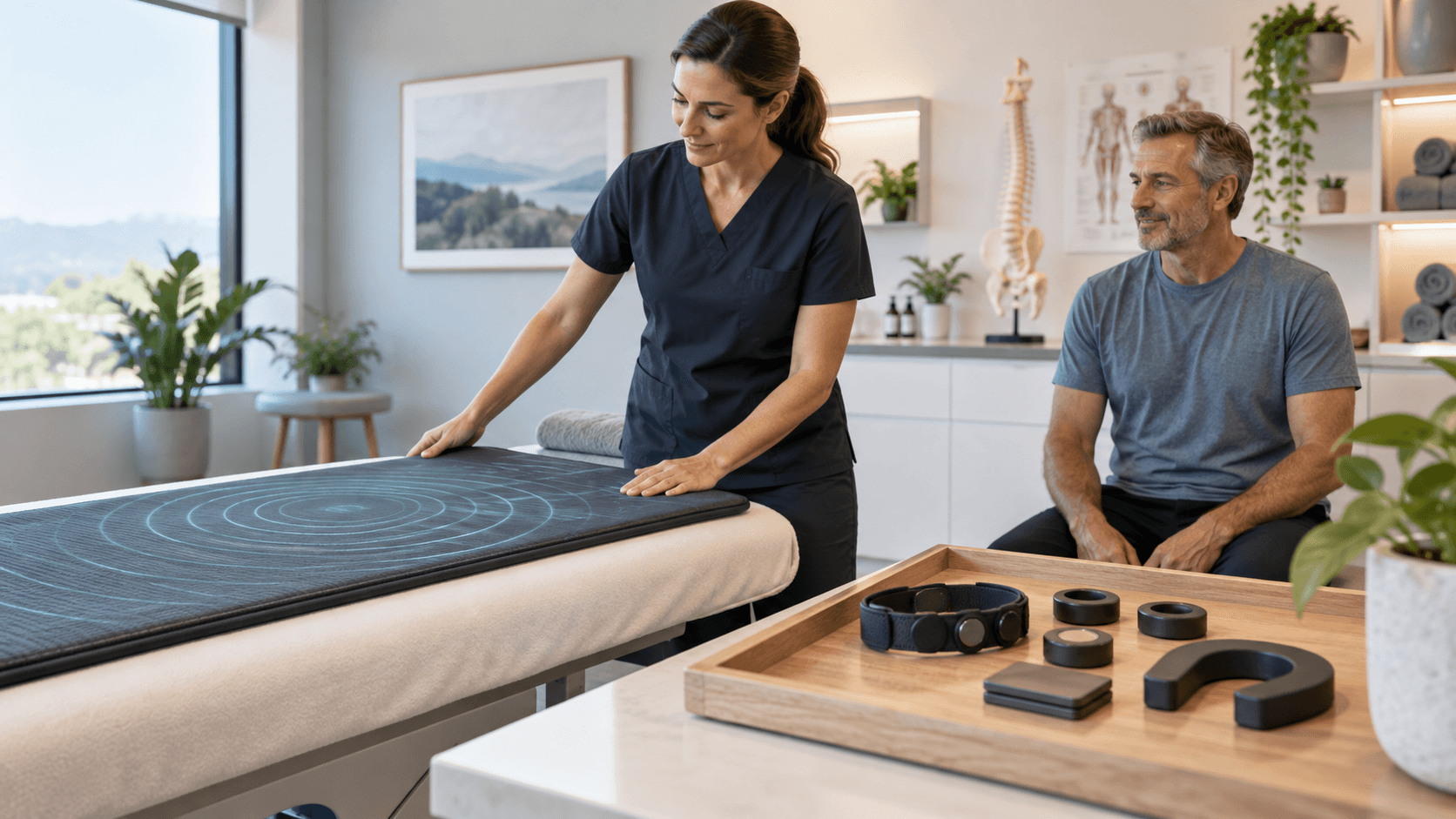
People often hear “magnet therapy” and picture one treatment. In stores and clinics you are usually comparing two different products. Static magnets are always on. They are sold as bracelets, shoe inserts, wraps, mattress pads, and jewelry. PEMF devices use a powered coil to pulse or change a magnetic field during a session.
The field strength on consumer static products is often in a range people compare with household magnets. Marketing may still claim improved circulation or pain relief. Those claims need their own evidence. A constant weak field is not the same intervention as a pulsed medical stimulator used after an orthopedic diagnosis.
Clinics may place both in a recovery menu: a magnet wrap at the front desk and a PEMF bed in a back room. Shared branding does not merge the research. You are choosing a product class, a dose, and whether anyone has examined the cause of your pain.
Neither option is a diagnosis. Osteoarthritis, tendinopathy, neuropathy, and delayed fracture healing are different problems. NIAMS describes established approaches for osteoarthritis that start with evaluation, activity, and conventional treatments. Magnets are not that foundation.
How they differ
The physics differ first. A static magnet’s field does not switch. PEMF is designed so the field changes, which is the feature manufacturers cite when they talk about induced electrical effects in tissue. That difference is why researchers and NCCIH discuss static magnets and electromagnetic therapy as separate topics.
Evidence differs. NCCIH says existing research on static magnets for pain is extremely limited, with no conclusive evidence of effectiveness for any form of pain. The Pittler systematic review of randomized trials, archived on PMC, concluded that the evidence does not support static magnets as an effective pain treatment.
Regulatory status differs. Some PEMF bone-growth stimulators are prescription medical devices with labeled orthopedic indications. Many static magnet consumer goods are sold as wellness accessories. A 510(k) on a pulsed device, if one exists, does not validate a bracelet. Wellness language is not a pain indication.
Practical use differs. Static products are worn for hours. PEMF sessions are usually timed and powered. Wear-time can create skin irritation or a false sense that something medical is happening. Session devices can create the opposite error: a dramatic machine that still has only weak evidence for your condition.
Who each option is for
A static magnet product is, at most, an optional comfort item for a person who already has a diagnosis and a care plan, understands the evidence is weak, and is not using it in place of indicated treatment. It is a poor fit when pain is unexplained, worsening, or associated with swelling, fever, or neurologic change.
Prescription PEMF may fit a person whose orthopedic clinician recommends a labeled bone-growth stimulator for a specific nonunion or fusion-adjunct indication. Wellness PEMF may be considered only as an adjunct for comfort if implants are screened and expectations stay modest. It is not a first-line arthritis plan.
People with implanted electronic devices should not self-select either product from a wellness menu. Ask the clinician who manages the implant and read the device label. “It is just a magnet” is not enough when the implant can sense or be affected by magnetic fields.
Children, pregnant people, and anyone with a suspected fracture or infection need conventional evaluation first. Magnet retail is not pediatric orthopedics or prenatal care. If a clinic offers magnets as the opening move for those situations, choose a licensed clinician instead.
Risks of choosing the wrong one
The largest risk is delay. NCCIH and orthopedic practice both point you toward evaluation when pain persists. Weeks in a magnet wrap can postpone physical therapy, a joint injection decision, or imaging for a bone that is not uniting. Weak evidence is most costly when it replaces stronger care.
A second risk is category error. You may pay clinic PEMF prices because a friend “used magnets,” or you may expect a bracelet to do what a prescription stimulator is labeled to do. Those are different products. Confusion here is common and expensive.
Safety is product-specific. Static consumer magnets are often low risk for healthy adults, but implants, insulin pumps, and some patches are listed as concerns on educational pages about magnet therapy. Powered PEMF adds electrical and field-strength questions that a bracelet does not answer.
False reassurance is a quieter harm. If pain fades for a week, you may assume the magnet treated osteoarthritis. Pain fluctuates. NIAMS notes that osteoarthritis management is broader than a single gadget. Attributing every good day to jewelry makes it harder to notice red flags.
How to decide
Name the symptom and the diagnosis you already have. If you do not have one, get one from a licensed clinician before you buy hardware. Ask whether any magnet product is even part of standard care for that diagnosis. For most pain conditions, the honest answer is that static magnets are not supported.
If a clinician is prescribing PEMF, ask which device, which indication, and how healing or function will be checked. If the offer is a wellness mat or a bracelet, treat it as optional and inexpensive only if you can afford to stop. Do not buy a year of either to “give it a real chance” when the evidence is already thin.
Screen implants and pregnancy the same day you ask about price. Bring a list of devices in your body. If staff cannot answer, do not proceed. Then keep your existing plan: activity as advised, medicines that are indicated, and follow-up imaging when a fracture is in play.
Set a short stop rule. If pain, walking distance, or sleep has not changed in a predefined window, stop the magnet product and return to the clinician. Switching from a bracelet to a PEMF bed without a new diagnosis is still shopping, not a stepped-care plan.
Frequently Asked Questions
References
NCCIH: Magnets for Pain: What You Need To Know
https://www.nccih.nih.gov/health/magnets-for-pain-what-you-need-to-knowPMC: Static magnets for reducing pain: systematic review and meta-analysis
https://pmc.ncbi.nlm.nih.gov/articles/PMC1976658/FDA: Premarket Notification 510(k)
https://www.fda.gov/medical-devices/premarket-submissions-selecting-and-preparing-correct-submission/premarket-notification-510kNIAMS: Osteoarthritis
https://www.niams.nih.gov/health-topics/osteoarthritis Your Privacy Choices