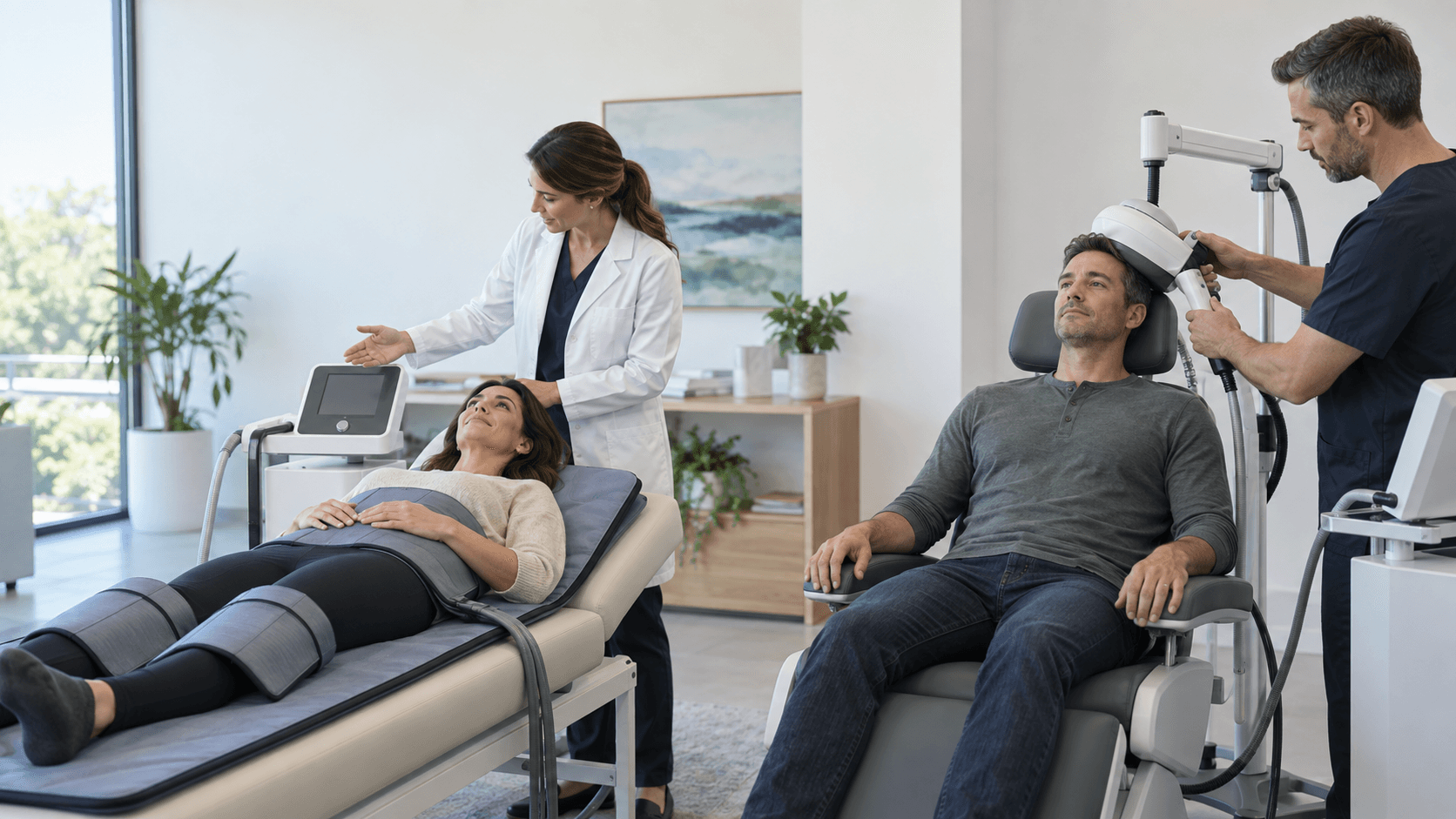
What you are comparing
TMS, usually repetitive transcranial magnetic stimulation, is a medical procedure. A coil on the scalp delivers brief, high-intensity pulses aimed at specific cortical targets. PEMF in longevity marketing usually means a mat, chair, or helmet that delivers broader pulsed fields for wellness or recovery claims.
Both use magnetism. That is where the useful overlap ends. TMS is prescribed after a psychiatric evaluation, dosed relative to motor threshold, and delivered as a course. Wellness PEMF is often booked like a massage. Comparing them only by the word magnetic is like comparing an MRI magnet with a souvenir magnet.
NIMH groups TMS with clinician-directed brain-stimulation therapies for specific mental disorders. Consumer PEMF does not appear there as a standard depression treatment. If a clinic blurs the names, ask them to say which device is on the schedule and who is medically responsible.
This comparison is for people deciding where to spend time and money for mood, focus, or “brain optimization.” It is not a reason to delay crisis care. Suicidal thoughts are an emergency. Use 988 or emergency services. Do not wait for either device.
How they differ
Intensity and targeting differ. TMS fields are strong enough, at mapped settings, to depolarize cortical neurons in a focal area. NIMH notes the magnetic field is on the order of MRI-level strength but pulsed. Wellness PEMF products typically advertise much lower, distributed fields. You cannot assume the same circuit is being stimulated.
Indications differ. FDA has cleared specific rTMS systems for labeled psychiatric uses, including major depressive disorder in defined adults who did not improve enough with prior antidepressant medication, with additional clearances on some systems for other listed uses. PEMF mats are commonly sold without a psychiatric indication.
Evidence and protocol differ. TMS trials use session counts, coil placement, and outcome scales. FDA’s special-controls guidance for rTMS systems describes performance and labeling expectations for that device type. PEMF wellness sessions rarely follow a psychiatric protocol or publish device-matched depression outcomes.
Supervision differs. TMS involves screening for seizure risk, implant issues, and psychiatric comorbidity. Side effects can include scalp discomfort or headache; seizures are uncommon but discussed. A PEMF bed may have a timer and a waiver. That is not equivalent monitoring.
Who each option is for
TMS may be appropriate for a person with a diagnosed depressive disorder who has not responded adequately to medicines, after a psychiatrist or qualified clinician reviews benefits, risks, and logistics. It can also be considered for other labeled indications on specific devices. It is not a walk-in wellness service.
Wellness PEMF may be an optional comfort session for someone who is already in mental-health care, understands it is not TMS, and has been screened for implants. It is a poor fit as the only plan for major depression, bipolar disorder, psychosis, or cognitive decline.
People in crisis, people who cannot stay safe, and people with mania or psychosis need urgent psychiatric care. Neither a TMS start date next month nor a PEMF package today is sufficient as the sole response. Stabilization comes first.
People with implanted electronic devices, certain metal in the head, or a seizure history need individualized screening before TMS and should not self-start magnetic wellness devices. Pregnancy requires clinician-specific advice. A longevity front desk cannot complete that clearance from a checkbox.
Risks of choosing the wrong one
The serious risk is undertreating depression. Weeks of PEMF while you skip therapy, medicine, or a TMS evaluation can worsen function and safety. Marketing that says “like TMS, gentler” is the mechanism of that delay.
The opposite error is also possible: you may fear TMS because a spa PEMF session felt odd, or you may think you already “tried magnets.” You have not tried TMS until you have been evaluated for a labeled protocol on a TMS system.
Financial harm is common. TMS courses are structured and sometimes covered when criteria are met. PEMF memberships are usually cash-pay. Spending the TMS copay money on mats can block the treatment that actually has a labeled indication.
Safety language can be misleading. TMS has known, uncommon risks that a medical team discusses. PEMF is not automatically safer for the brain; it is a different dose. Implant accidents and skipped crisis care are still possible when people treat a waiver as a psychiatric exam.
How to decide
If the goal is treatment of a depressive disorder, book licensed mental-health care first. Ask whether TMS is indicated for you, which device would be used, and what the course looks like. Use NIMH’s brain-stimulation page as a plain-language map of medical options, including ECT when that is the indicated discussion.
If a clinic offers “TMS/PEMF,” ask them to pick one noun. Request the device name, 510(k) number, indication-for-use statement, and the name of the prescribing clinician. If they cannot produce those, you are not being offered TMS.
Keep safety first. If you have suicidal thoughts, use 988 or emergency care now. Device comparisons can wait. Do not combine alcohol, unused medicines, and isolation with a home helmet experiment.
If you still want a wellness PEMF session for relaxation after a clinician agrees, keep it separate from the psychiatric plan. Do not change medicines because a mat felt good. Reassess mood with your clinician, not with a device dashboard. The right next step is almost always care for the diagnosis, not a new magnetic brand.
Frequently Asked Questions
References
NIMH: Brain Stimulation Therapies
https://www.nimh.nih.gov/health/topics/brain-stimulation-therapies/brain-stimulation-therapiesNIMH: Depression
https://www.nimh.nih.gov/health/topics/depressionFDA: Premarket Notification 510(k)
https://www.fda.gov/medical-devices/premarket-submissions-selecting-and-preparing-correct-submission/premarket-notification-510kFDA: rTMS Systems Class II Special Controls Guidance
https://www.fda.gov/medical-devices/guidance-documents-medical-devices-and-radiation-emitting-products/repetitive-transcranial-magnetic-stimulation-rtms-systems-class-ii-special-controls-guidanceNIMH: Suicide Prevention
https://www.nimh.nih.gov/health/topics/suicide-prevention Your Privacy Choices