What this means
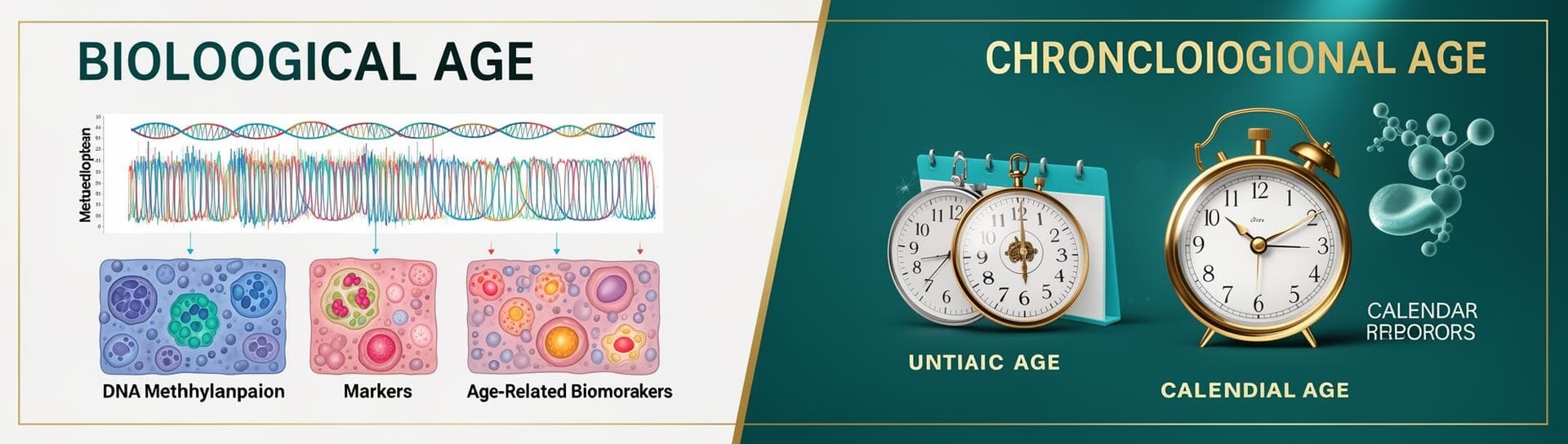
Chronological age is calendar time since birth. It is simple, stable, and still one of the strongest markers we have for screening schedules and many disease rates. When USPSTF names an age to start a test, it means this number, plus other clinical facts, not a vendor score.
Biological age is a nickname for an estimate. A model reads selected inputs—often DNA methylation, sometimes routine labs, fitness, or proteomics—and outputs a year-like number. NHGRI’s epigenomics fact sheet explains that chemical marks can change gene use without changing DNA letters. That biology is real. The leap from a mark to “you are 41” is a statistical story.
There is no single biological age. Two clocks can place the same person on different sides of their birthday because they were trained on different tissues, ancestries, and outcomes. A younger heart-age app and an older methylation age can both print on one clinic report. That is confusion, not precision.
This guide is for adults who received a biological-age number and want to know what it can and cannot do. It is not a promise that lowering the number extends life. NIA materials on healthy aging still emphasize behaviors and medical care you can name, not a proprietary year.
What the evidence shows
Some methylation clocks associate with later disease, disability, or death in research cohorts. Horvath and Raj’s review describes clocks as useful research biomarkers with technical and interpretative limits. Association at a group level is not a diagnosis for one person and is not proof that moving the score is the same as moving the outcome.
Chronological age remains the backbone of prevention schedules. Colorectal, breast, cervical, and other USPSTF services use calendar age and risk factors. A clinic that replaces those ages with a clock is practicing marketing, not guideline care. CDC genetic-testing pages also remind patients that genomic tools need clinical context; a wellness age is even less directive.
Inputs matter. Blood-cell composition, recent infection, smoking, and lab platform can shift methylation estimates. Routine-lab “phenotypic ages” move when you are dehydrated or on a steroid taper. Fitness-based ages move when the protocol or the watch changes. Compare only like with like, and ask for uncertainty, not a single integer.
Intervention trials that treat the clock as the primary goal are still limited. Even if a diet or exercise program improves a score, the health win is usually the blood pressure, glucose, or walking capacity you could have tracked without the clock. Do not pay twice for the same behavior change.
Common myths
Myth: biological age is your “real” age. It is a model output. Chronological age is the measurement. Calling the estimate real hides the training set, the error bar, and the vendor version.
Myth: a younger score means you can wait on screening. Screening intervals were not written for commercial clocks. Delaying a mammogram or colonoscopy because a report said you were “32 inside” is a harm pathway.
Myth: a worse score means the clinic protocol failed, or a better score means it worked. You may have changed assays, had a cold, or lost water weight. Without a locked method and a pre-specified outcome, the year is a story.
Myth: you can reverse aging in a month with a stack. NIA healthy-aging pages do not treat supplements as an aging cure. Rapid clock claims are a reason to ask for the protocol, the lab, and the conflict of interest, then keep ordinary care.
How clinics use it
Better clinics present a clock as optional context after they have measured blood pressure, lipids, glucose, and screening status. They name the model. They do not titrate hormones or peptides to the year. They do not tell you the number is confidential medical genetics when it is a wellness assay.
Sales-driven clinics lead with the age gap. They resell the test every quarter. They pair a “worse” result with IVs, peptides, or unapproved biologics. Ask what licensed decision the second test will change. If the answer is only “track your optimization,” you are funding a dashboard.
Some programs blend clocks with true genetic testing. Keep those reports separate. A hereditary cancer variant needs counseling and a medical plan. A methylation year does not. Mixing them on one PDF makes the clock look like clinical genetics.
Employers and concierge memberships may display biological age as a team metric. That raises privacy issues. Age-like genomic data can be identifying. Ask who stores it and whether you can decline without losing indicated medical care.
Practical takeaway
Keep chronological age for screening and for conversations about average risk. Use biological-age scores, if at all, as a research-grade extra after the basics are done. Write down the model, tissue, and date so you do not compare incompatible numbers.
Do not change medicines, skip imaging, or buy a regenerative package because of a year gap. Treat blood pressure, lipids, tobacco, activity, sleep, and indicated cancer screening. Those actions have clearer evidence than any clock.
If you enjoy the number, budget it like a hobby test. One baseline is enough for most people. Repeat only in a study or when the same validated method will answer a question you can state in a sentence.
A younger biological age is not a longer life. An older score is not a sentence. Chronological age still sets the screening calendar. Licensed care still sets treatment. The useful question is what you will do next that does not depend on the vendor’s model.
Frequently Asked Questions
References
USPSTF: A and B Recommendations
https://www.uspreventiveservicestaskforce.org/uspstf/recommendation-topics/uspstf-a-and-b-recommendationsNHGRI: Epigenomics Fact Sheet
https://www.genome.gov/about-genomics/fact-sheets/Epigenomics-Fact-SheetNIA: What Do We Know About Healthy Aging?
https://www.nia.nih.gov/health/healthy-aging/what-do-we-know-about-healthy-agingCDC: Genetic Testing
https://www.cdc.gov/genomics-and-health/counseling-testing/genetic-testing.htmlPMC: DNA methylation-based biomarkers and the epigenetic clock theory of ageing
https://pmc.ncbi.nlm.nih.gov/articles/PMC5940111/ Your Privacy Choices