What you are comparing
Cold therapy uses one temperature: ice, a cold pack, or cold water. Contrast therapy alternates heat and cold, usually as a warm whirlpool then a cool plunge, or as alternating packs. Athletic facilities sell both for soreness after hard training. They are comfort and circulation experiments, not treatments that change a diagnosis.
NIAMS still points people with many minor sports injuries toward rest and ice, not toward a contrast circuit. MedlinePlus likewise starts muscle-strain care with ice for the first days. Contrast sequences are an extra layer some therapists use later, when swelling is controlled and the skin is intact. A longevity studio that offers contrast as a weekly membership is not automatically following that medical sequence.
You are deciding whether a single cold dose or a hot-cold cycle is worth the extra complexity and risk. The comparison that helps is evidence for recovery, skin and vascular safety, and whether a licensed clinician has cleared the site. Feeling refreshed after a session does not prove that tissue healed faster.
How they differ
Mechanism claims differ. Cold is meant to numb pain and may limit early swelling. Contrast is marketed as a pump: vessels narrow in cold and widen in heat. That story is plausible physiology. It is not proof that alternating temperatures outperforms simpler care for your injury.
Evidence for contrast is mixed. A PubMed Central systematic review of contrast water therapy after exercise-induced muscle damage found less soreness versus passive recovery at several time points, but contrast was not clearly superior to cold water, compression, or other active methods. Later small trials still show variable performance effects. Mixed evidence is a reason for a time-limited trial, not a package you cannot cancel.
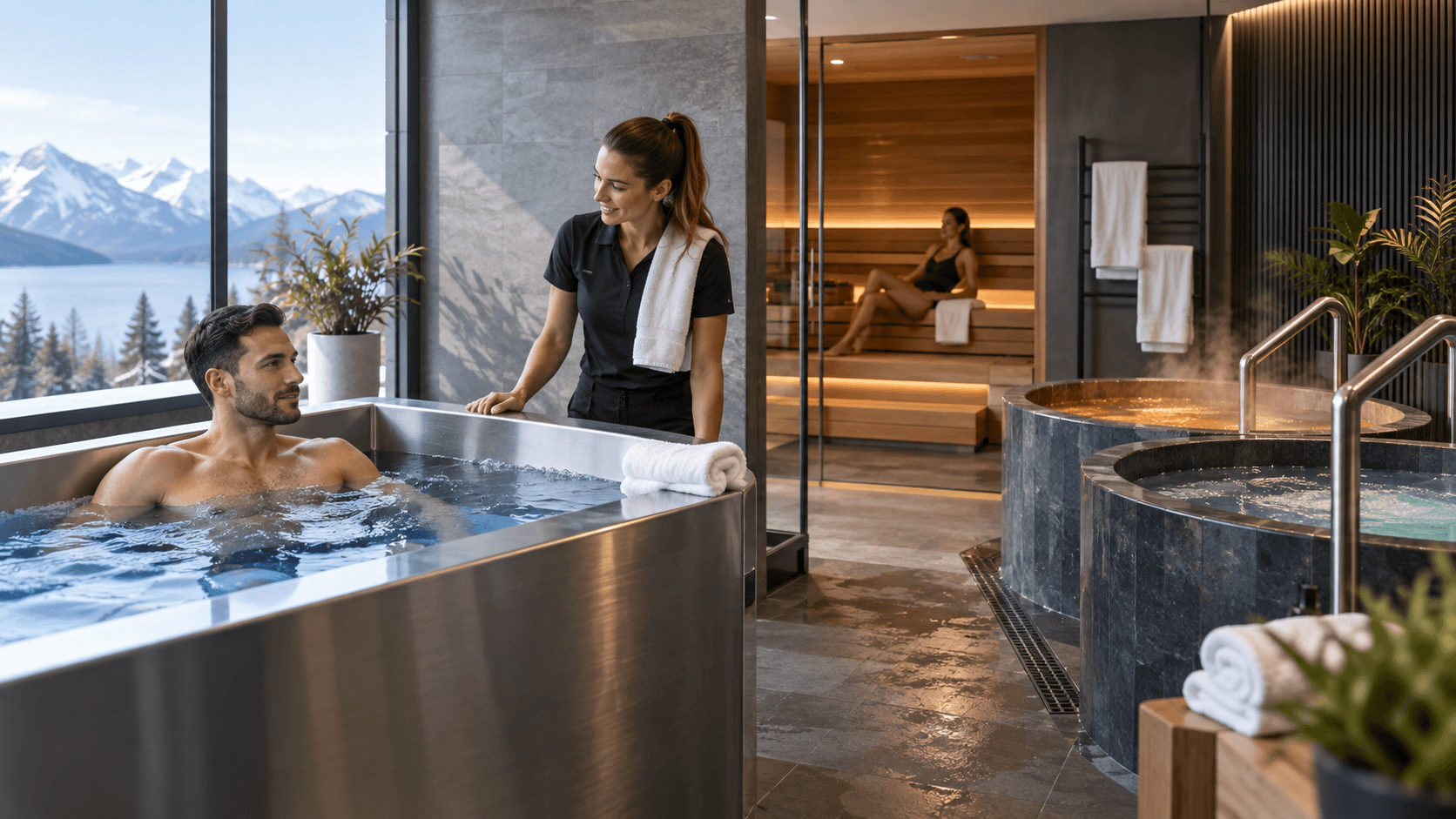
Logistics differ too. Cold at home is a wrapped pack and a timer. Contrast usually needs two tubs or a clinic circuit and a plan for how long you stay in each. More steps mean more chances to overheat, overcool, or soak an open area. After surgery, immersion rules are stricter than a gym whiteboard.
- Cold only: simpler; typical early choice for new swelling if the skin is intact.
- Contrast: more complex; used later for soreness in some sports settings; evidence mixed.
- Neither without clearance: open wounds, infection, vascular disease, or a suspected blood clot.
Who each option is for
Cold alone may fit the first days after a simple sprain or strain, following NIAMS and MedlinePlus home advice, if you can protect the skin and you have no vascular red flags. It may also fit after a workout when a physical therapist has already said a short ice interval is acceptable.
Contrast may fit a medically screened athlete with intact skin who wants a supervised recovery session and understands that soreness relief is the realistic goal. It is a poor fit as first-line care for a hot, swollen new injury, and a poor fit if you have peripheral artery disease, neuropathy, or a history of clots. NHLBI describes PAD as reduced limb blood flow; temperature swings on those limbs need a clinician, not a spa attendant.
People with open wounds, cellulitis, fever, or a surgical incision that is not cleared for soaking should stay out of contrast tubs. Water plus broken skin is an infection risk. People who cannot get out of a deep tub safely, or who become lightheaded with heat, need a different plan.
Neither option is for unexplained calf swelling, chest pain, or sudden shortness of breath. NHLBI’s venous thromboembolism pages treat those as medical emergencies. A contrast circuit is not a clot workup.
Risks of choosing the wrong one
Choosing contrast too early can increase swelling if heat is applied when the tissue is still acutely inflamed. Choosing endless cold without rehab can leave strength and motion unaddressed. NIAMS reminds people that rehabilitation is often required before return to the activity that caused the injury.
Skin and nerve injury happen when sessions run long or barriers are skipped. Contrast adds burn risk on the heat side and frostbite risk on the cold side. Infection risk rises if tubs are shared and skin is broken. A clinic that cannot describe cleaning, time limits, and exclusion rules is not a careful setting.
Vascular and cardiac stress are the systemic risks. Rapid heating can drop blood pressure. Rapid cooling can raise it. People with heart disease or poorly controlled blood pressure should not treat a contrast plunge as a harmless extra. Fainting in water is an emergency, not a detox feature.
Opportunity cost matters. Money spent on a contrast membership is money not spent on physical therapy, sleep, or load management. If a coach tells you to skip an orthopedic visit because the contrast tub will “flush inflammation,” that is the wrong clinician.
How to decide
Match the tool to the phase. New swelling: wrapped cold, rest, and a medical screen if you cannot walk or the joint looks wrong. Later soreness with intact skin: ask a physical therapist whether cold, contrast, or just active recovery is worth trying. If the answer is “either is optional,” pick the simpler one you can do safely at home.
- Have a licensed clinician inspect the skin and ask about clots, diabetes, and artery disease.
- Get written times for each temperature and a stop rule for dizziness, mottling, or worse pain.
- Do not immerse incisions or open wounds unless the surgical team said the barrier is closed.
- Review in two weeks using function and soreness, not loyalty to a tub membership.
Walk away if staff promise faster healing, disease modification, or toxin clearance from alternating temperatures. Contrast is a mixed-evidence recovery extra. Cold is a short-term adjunct. Licensed care decides when either is appropriate.
Frequently Asked Questions
References
PMC: Contrast Water Therapy and Exercise-Induced Muscle Damage (Systematic Review)
https://pmc.ncbi.nlm.nih.gov/articles/PMC3633882/NIAMS: Sports Injuries — Diagnosis, Treatment, and Steps to Take
https://www.niams.nih.gov/health-topics/sports-injuries/diagnosis-treatment-and-steps-to-takeMedlinePlus: Muscle Strain Treatment
https://medlineplus.gov/ency/article/002116.htmNHLBI: Peripheral Artery Disease
https://www.nhlbi.nih.gov/health/peripheral-artery-diseaseNHLBI: Venous Thromboembolism
https://www.nhlbi.nih.gov/health/venous-thromboembolism Your Privacy Choices