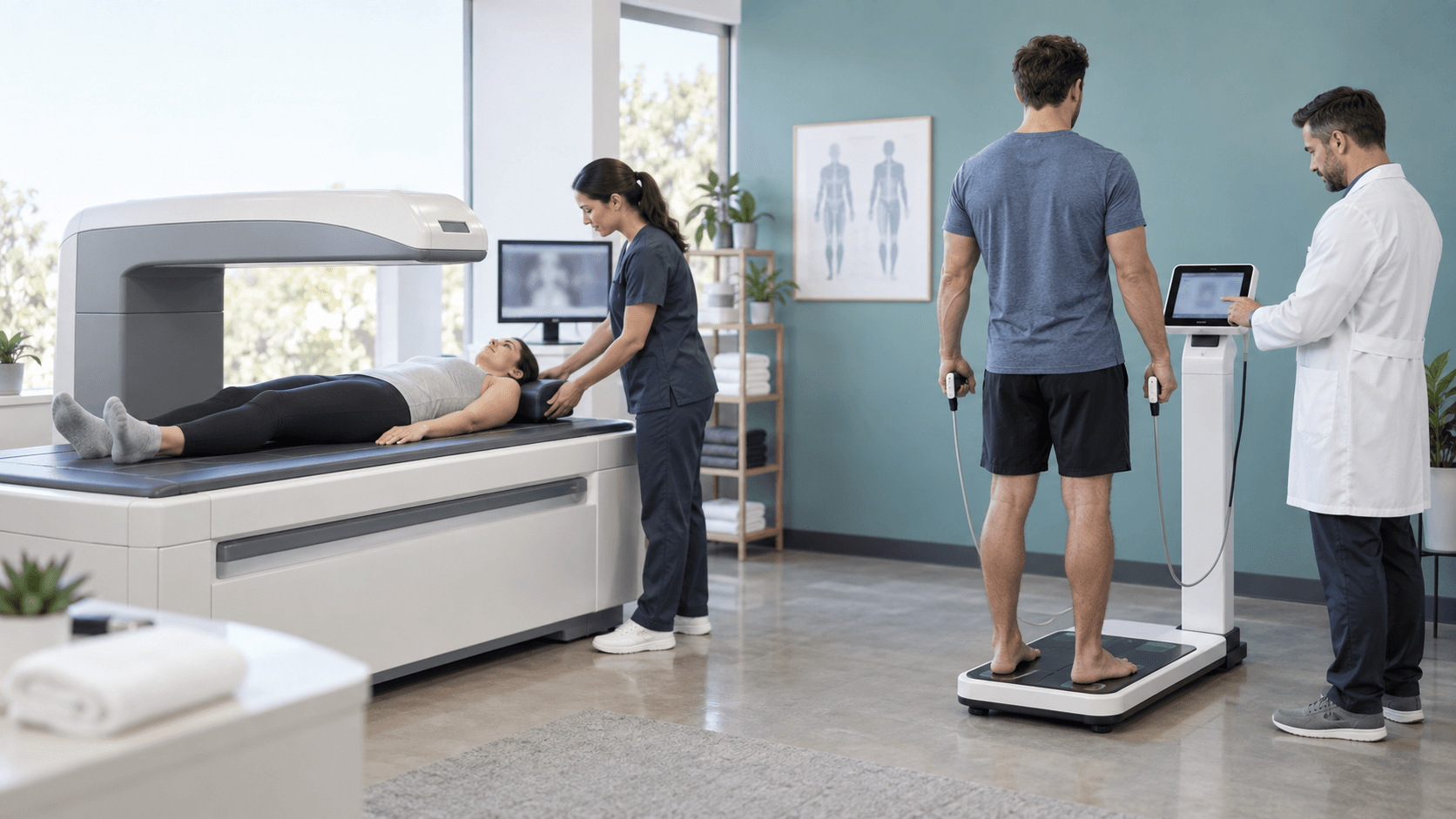
What you are comparing
Clinics sell two common ways to estimate what your body is made of. DXA, also written DEXA, uses two low-dose X-ray energies to separate bone mineral from soft tissue and then split soft tissue into fat and lean compartments. BIA, or bioelectrical impedance analysis, sends a small current through the body, estimates water, and applies equations for fat-free mass and fat mass.
Those outputs can look similar on a printout: body-fat percentage, lean mass, sometimes visceral-fat estimates. The methods are not the same measurement. DXA is an imaging-based compartment model. BIA is an electrical and statistical model. A three-point difference between them is often method noise, not a sudden physiologic change.
Longevity and fitness studios may offer whole-body DXA as a composition package, a standing BIA scale, or both in one membership. Primary-care and endocrinology clinics more often use central hip-and-spine DXA when the question is bone density and fracture risk. NIAMS and USPSTF materials describe that bone test as a medical screening tool, not a gym report.
You are comparing precision and convenience, not a verdict on your health. NIDDK overweight pages still treat blood pressure, lipids, glucose, sleep, and function as the medical picture. Neither scan replaces that evaluation. The useful comparison is which tool answers the question you actually have.
How they differ
Precision and compartments differ first. Clinic DXA generally gives more repeatable bone, fat, and lean estimates and can report regional values such as arms versus legs. BIA is more sensitive to hydration, recent food, glycogen, alcohol, and skin temperature. A dehydrated or post-workout BIA can look “leaner” without a true tissue change.
Radiation and access differ next. DXA uses a small X-ray dose. That dose is low compared with many diagnostic CT scans, but it is not zero, and pregnancy is a standard reason to pause. BIA uses no ionizing radiation and can be repeated often. Convenience is BIA’s main advantage, not superior accuracy.
Clinical meaning differs third. A hip-and-spine DXA interpreted with T-scores and fracture-risk factors is a bone-health study. A whole-body composition DXA is usually a different protocol and software path. BIA never measures bone mineral density the way diagnostic DXA does. Do not treat a scale’s “bone mass” line as osteoporosis screening.
Error sources differ last. DXA results change with machine, software, positioning, and sometimes clothing or recent contrast. BIA results change with electrode placement, device equations, and whether the population you belong to matches the equation. CDC’s NHANES program has used standardized DXA protocols in population research; a storefront BIA kiosk is not that protocol.
Who each option is for
Diagnostic hip-and-spine DXA is for people whose clinicians are following osteoporosis screening recommendations—for example many women 65 and older, and some younger postmenopausal women at increased risk, as USPSTF describes. That visit should include interpretation and a plan if bone density is low. It is not a casual add-on photo.
Composition DXA may help when you and a clinician want a more standardized look at fat and lean change during a structured weight or rehabilitation program, or when regional asymmetry matters. It is a poor first purchase if you have never had blood pressure checked or you are seeking a diagnosis from a percentage.
BIA is for frequent, low-burden trends if you accept hydration noise and use the same device under similar conditions. It can support coaching conversations about consistency. It is a poor tool for medical decisions, medication changes, or proving that a supplement “rebuilt muscle” in two weeks.
Neither test is for people who need evaluation of edema, unexplained weight change, an eating disorder, or endocrine disease. Those are clinical problems. A reassuring or alarming composition printout can distract from the exam you actually need. Pregnant people should ask before any X-ray-based scan.
Risks of choosing the wrong one
Using BIA as if it were diagnostic DXA can miss bone-health decisions. A standing scale that says your “bone mass is fine” does not complete USPSTF-aligned osteoporosis screening. Using composition DXA as if it were a full medical exam can miss hypertension, diabetes, and medication issues that drive risk more than a fat-percentage decimal.
Over-reacting to noise is common with BIA. People cut food or add extra cardio because impedance rose after a salty dinner. That response can worsen lean-mass loss during weight reduction. DXA has noise too; changes smaller than the machine’s precision are not a reason to overhaul a plan.
Radiation stacking is a smaller but real issue if you collect whole-body DXA the way some people collect blood panels. Ask how often the clinic wants repeats and whether a hip-and-spine study is also planned. More scans are not more prevention if no decision will change.
Shame and false reassurance are interpersonal risks. A composition number can be used to sell peptides, hormones, or extreme diets. It can also be used to tell you that you are “healthy” while blood pressure is ignored. NIDDK health-risk pages keep the medical outcomes in view. The scan should serve that conversation, not replace it.
How to decide
Name the question. If it is fracture risk and osteoporosis screening, ask for a diagnostic central DXA and a clinician interpretation. If it is tracking fat and lean during a supervised program, a composition DXA at wide intervals may be reasonable. If it is weekly curiosity, BIA or even waist and strength measures may be enough.
Standardize the method you keep. Same machine, similar time of day, similar food and fluid, and no hard workout immediately before BIA. Ask the clinic for its precision error so you know what change is worth noticing. Pair any composition number with function: walking, lifting, work capacity, and how you feel.
Keep medical care in charge. Share results with the clinician who manages your medicines. Do not start or stop therapy because a kiosk printed a visceral-fat cartoon. If swelling, fatigue, or rapid weight change appears, book an exam rather than another scan package.
Choose the smallest test that answers the question. DXA is generally the more precise clinic tool for bone, fat, and lean compartments. BIA is the more convenient, hydration-sensitive estimate. Neither one is a physical, a diagnosis, or a reason to skip indicated screening. Use them as measurements, not as verdicts.
Frequently Asked Questions
References
NIAMS: Bone Mineral Density Tests
https://www.niams.nih.gov/health-topics/bone-mineral-density-tests-what-numbers-meanUSPSTF: Osteoporosis Screening
https://www.uspreventiveservicestaskforce.org/uspstf/recommendation/osteoporosis-screeningNIDDK: Health Risks of Overweight and Obesity
https://www.niddk.nih.gov/health-information/weight-management/adult-overweight-obesity/health-risksCDC: NHANES
https://www.cdc.gov/nchs/nhanes/index.html Your Privacy Choices