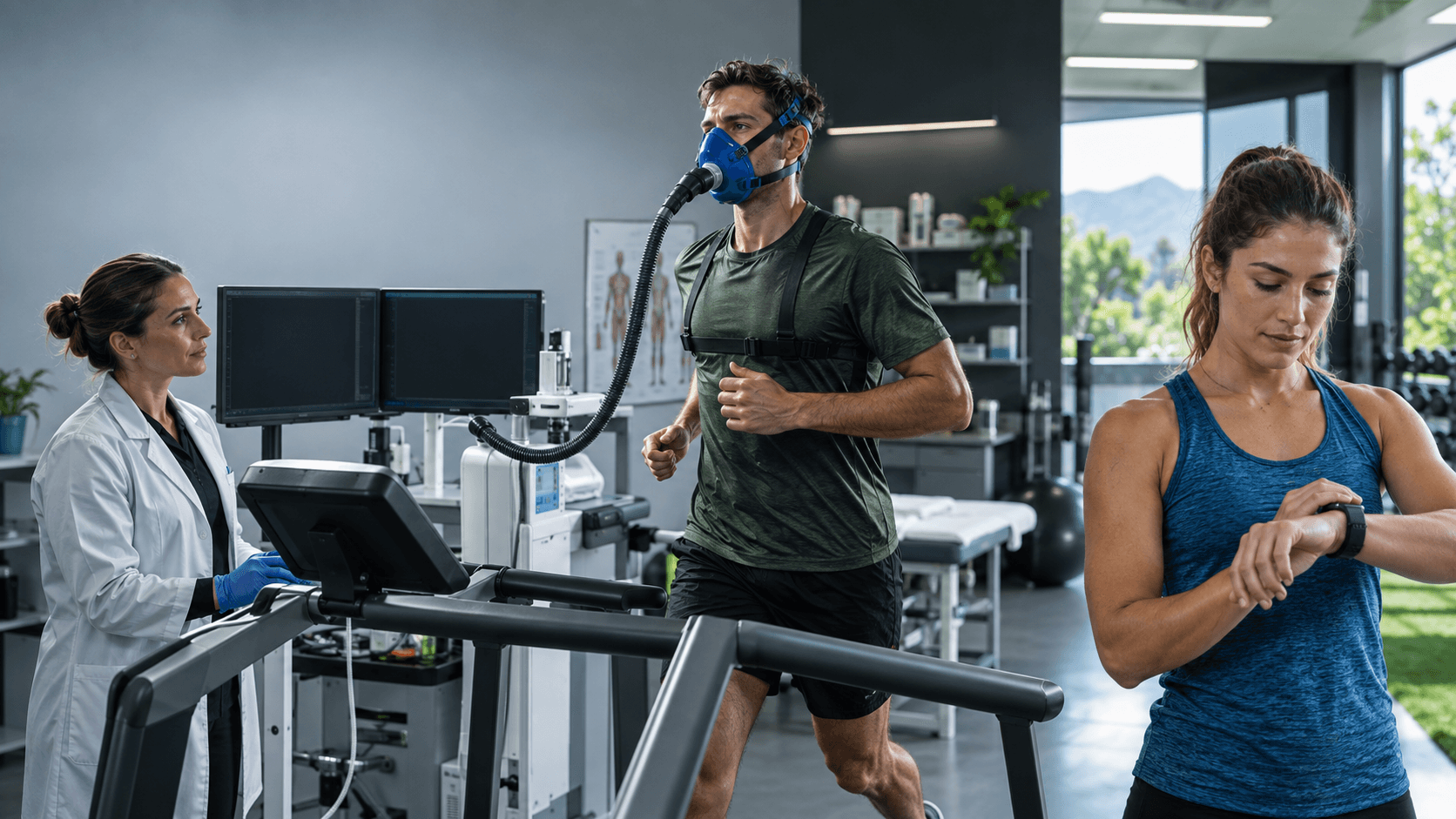
What you are comparing
Both numbers are often labeled VO2 max, so they look interchangeable on a dashboard. They are not. A laboratory cardiopulmonary exercise test, or CPET, measures gases you breathe out while you exercise on a treadmill or cycle ergometer. A wearable estimate infers a fitness value from heart rate, speed or power, age, sex, and a vendor algorithm during everyday activity.
Lab testing can include ECG, blood-pressure checks, oxygen saturation, and a clinician who stops the test for safety. That is a diagnostic or performance procedure with calibration and a protocol. A wrist or finger sensor is a convenience product. It can still be useful for trends. It does not become a CPET because the app uses the same units.
Longevity clinics sometimes sell “VO2 max” as a single headline. Ask whether they mean expired-gas analysis in a lab, a submaximal step test, or a watch sync. Those visits answer different questions. Mixing them makes a training log look like a medical file.
You are comparing a measured physiologic test with a modeled consumer metric. The decision is which job you need done: clinical or precise threshold work versus frequent, low-burden tracking. CDC and ACSM activity guidance still apply either way. A higher watch number is not a diagnosis, and a lower one is not a disease by itself.
How they differ
Measurement versus estimation is the first difference. In a CPET, oxygen uptake is calculated from ventilation and mixed-expired gas. Peak or maximum values depend on effort and protocol. Wearables rarely measure those gases. They predict a number from pulse and external work. Prediction error grows when the pulse signal is poor or the activity is unlike the model’s training data.
Context is the second difference. Lab tests are controlled: known grade or watts, a warm-up, and often a true near-maximal effort. Watches collect messy outdoor minutes. Heat, hills, drafting, cadence, and optical heart-rate dropouts all move the estimate. Two people with the same lab value can show different watch numbers for that reason alone.
Output is the third. A clinical CPET report can include ventilatory thresholds, breathing reserve, heart-rate and blood-pressure responses, and reasons the test stopped. A wearable gives a single score, sometimes a recovery metric, and a color. Those extras are not equivalent to a interpreted gas-exchange study.
Oversight is the fourth. Lab testing for symptoms should have screening and emergency readiness. A watch update happens while you shop. That convenience is the point of a wearable. It is also why a new chest pain or fainting spell belongs in licensed care, not in a firmware comparison thread.
Who each option is for
Lab CPET is for people who need measured gas exchange: unexplained dyspnea on exertion, known heart or lung disease when a clinician wants objective limits, preoperative or transplant-path questions, or athletes who need thresholds from a calibrated protocol. It is also reasonable when a clinic will change a medical decision based on the result, not only print a souvenir graph.
Wearable estimates are for people who want frequent feedback while they follow ordinary activity guidance. CDC adult recommendations still center minutes of moderate or vigorous activity and muscle-strengthening days. A watch can show whether your usual runs are trending easier or harder. That is a coaching aid, not a cardiopulmonary diagnosis.
Some longevity clients want both: a periodic lab baseline and daily watch trends. That pairing only helps if you keep the methods separate. Do not “correct” a CPET with last week’s watch, or panic because the watch sits a few points away from the lab. Use each tool for the job it can do.
Neither option is for diagnosing chest pain, syncope, or a sudden drop in exercise capacity. Those symptoms need a clinician. NHLBI heart-test and activity pages treat medical evaluation as separate from general fitness tracking. A boutique VO2 session does not replace indicated cardiac testing when red-flag symptoms are present.
Risks of choosing the wrong one
Treating a wearable as a CPET can delay care. A falling watch score after a viral illness, anemia, or arrhythmia is a clue to get evaluated. A rising score does not create a clean bill of health. People have had cardiac events with reassuring consumer metrics. The method was never designed as a rule-out test.
Treating a lab test as casual fitness theater has costs too. You pay more, you may exercise to a true maximum, and you may get incidental ECG findings that need follow-up. If you have no clinical question and no need for thresholds, a watch trend plus a regular activity habit may be enough. Extra testing is not automatically better prevention.
Mis-training is a quieter risk. Chasing a watch VO2 with interval spikes can overload someone who needed a medical screen first. Conversely, ignoring symptoms because a lab VO2 looked “good last year” is unsafe. Fitness numbers age. Symptoms do not wait for the next membership package.
Comparison shopping between brands creates false precision. Switching watches, wrist tightness, or winter gloves can move the estimate more than your physiology did. Lab-to-lab differences exist as well if protocols change. The wrong choice is any plan that treats a three-point swing as a medical event or a personal failure.
How to decide
Write the decision you need. If the question is “why am I limited, and is it safe to push,” ask for licensed evaluation, which may include CPET or other heart and lung tests. If the question is “am I staying active enough this month,” use minutes, resistance days, and a consistent wearable trend. ACSM and CDC materials support the second question without a mask.
If you book a lab test, ask what is measured, whether a clinician interprets it, how maximal effort is judged, and who follows an abnormal ECG. If you rely on a watch, keep the same device, similar routes, and similar conditions when you compare months. Ignore single-day jumps after poor sleep or a tight band.
Do not let a longevity menu collapse the two. A studio that calls a bike-and-watch session a medical VO2 max test is selling language. A hospital lab that never explains the report is incomplete care. You should leave with a method name and a next step, not only a percentile.
Keep activity itself as the outcome that matters for most adults. Guidelines still reward regular aerobic and strengthening work. Use lab gas analysis when the clinical or precision job requires it. Use the wearable as a trend tool. Never treat the wrist number as a cardiopulmonary exercise test.
Frequently Asked Questions
References
CDC: What Counts as Physical Activity for Adults
https://www.cdc.gov/physical-activity-basics/adding-adults/what-counts.htmlPMC: The Physical Activity Guidelines for Americans
https://pmc.ncbi.nlm.nih.gov/articles/PMC9582631/ACSM: Physical Activity Guidelines Resources
https://acsm.org/education-resources/trending-topics-resources/physical-activity-guidelines/NHLBI: Heart Tests
https://www.nhlbi.nih.gov/health/heart/physical-activity Your Privacy Choices