What this means
VO2 max is the highest rate of oxygen your body can use during progressive exercise, usually reported in milliliters per kilogram per minute. It reflects the heart, lungs, blood, and working muscle together. It is a fitness measurement, not a personality trait and not a lifespan certificate.
AHA statements treat cardiorespiratory fitness as a clinical vital sign because low fitness associates with higher cardiovascular and all-cause mortality. That is why longevity clinics advertise it. Association is not a personal expiration date. A high value does not make chest pain safe. A modest value does not mean training is pointless.
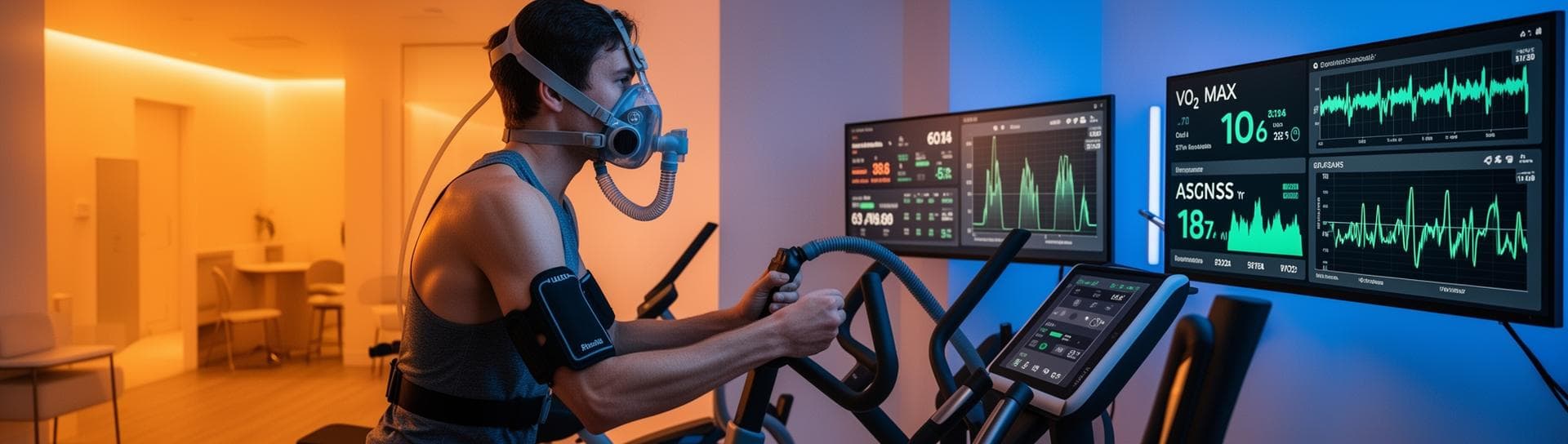
How you measure it changes what the number means. Laboratory CPET uses expired-gas analysis. Field tests and wearables estimate. Relative VO2 also falls when body weight rises even if the engine is unchanged. Ask whether you are looking at a measured peak, a predicted peak, or a watch model.
This page is for adults comparing a clinic treadmill test with a wrist estimate. It is not an exercise prescription and it is not clearance for a race. Symptoms, medicines, and known heart or lung disease belong with a physician, NP, PA, or clinical exercise physiologist first.
What the evidence shows
Population studies repeatedly link higher CRF with better survival statistics. The 2016 AHA scientific statement on fitness as a vital sign summarizes that signal and notes that adding fitness can refine risk beyond smoking, blood pressure, cholesterol, and diabetes alone. Refining risk is not the same as guaranteeing a longer life for one patient.
Exercise training can raise CRF. A JAHA meta-analysis of trials found that structured exercise improved measured fitness and some cardiometabolic markers. AHA and CDC activity guidelines still recommend a mix of aerobic and muscle-strengthening work for most adults. Those guidelines exist whether or not you ever sit on a metabolic cart.
CPET adds more than a single VO2 number. AHA’s clinician guide describes gas-exchange thresholds, breathing reserve, heart-rate and blood-pressure responses, and symptom correlation. Those details can help unexplained dyspnea or preoperative questions when a trained team interprets them. A boutique “max” without ECG review is a thinner test.
Estimated CRF from wearables can track trends if the device, sport, and health status stay similar. It can mislead when you start a beta blocker, change watches, hike in heat, or are anemic. Do not let a green fitness ring replace a workup for new exercise intolerance.
Common myths
Myth: there is a magic VO2 that equals longevity. Percentiles depend on age, sex, protocol, and the reference set. Chasing a social-media cutoff can push unsafe intervals. Function and symptom-free activity matter more than a branded threshold.
Myth: the watch is a lab. Consumer estimates are convenient. They are not expired-gas measurement. If a clinic quotes your watch as if it were CPET, ask them to say so in writing.
Myth: raising VO2 max reverses aging. Training can improve fitness and many risk markers. That is valuable. It is not evidence that you added years. Weight-loss-only jumps in relative VO2 can also look like “anti-aging” on a dashboard.
Myth: everyone needs a maximal test this year. Many adults can follow CDC activity guidance without a cart. Testing is more useful when it changes a training plan, evaluates symptoms, or informs a medical decision. It is less useful as a membership trophy.
How clinics use it
Stronger programs use measured CPET or a supervised clinical exercise test when the result will change training intensity, explain dyspnea, or complement cardiology care. They screen for contraindications. They report protocol, respiratory exchange ratio, and whether the effort was truly maximal. They send abnormal ECG or blood-pressure findings to a physician.
Weaker programs take a submaximal bike number, label it VO2 max, and sell zones or oxygen therapies. Some pair a low score with unapproved peptides or IVs. Ask what diagnosis they think they are treating. Fitness is not a license for those products.
Performance clinics may retest every 8 to 16 weeks. That can make sense if the protocol is identical and you are changing training. It is wasteful if the first test was a watch export. Keep shoes, time of day, and illness notes so you are not comparing noise.
Insurance coverage varies. Clinical CPET for a medical indication is different from a cash longevity package. Ask which code, if any, is being used, and who is medically responsible if you feel chest pressure on the treadmill.
Practical takeaway
Treat cardiorespiratory fitness as a meaningful, trainable marker with strong outcome associations. Measure it in a way that matches the decision. Use lab CPET when you need a medical-grade number. Use a consistent field test or wearable only as a trend, and say so.
Train with a plan you can sustain: regular aerobic volume, some harder efforts if cleared, and strength work. AHA and CDC pages already describe that pattern. You do not need a longevity brand to start walking and lifting safely.
Stop a test and seek care for chest pain, severe unexpected dyspnea, fainting, or neurologic symptoms. A fitness number never outranks those signs. People with known cardiac disease need their treating clinician’s rules, not a social-media interval set.
Retest only if the result will change programming. Compare the same method. Pair the number with what you can do in life: stairs, a timed walk, work capacity. Raising fitness is a health goal. It is not a lifespan guarantee, and a wrist estimate is not a laboratory VO2 max.
Frequently Asked Questions
References
AHA: Importance of Assessing Cardiorespiratory Fitness in Clinical Practice
https://www.ahajournals.org/doi/10.1161/CIR.0000000000000461AHA: Clinician’s Guide to Cardiopulmonary Exercise Testing in Adults
https://www.ahajournals.org/doi/10.1161/CIR.0b013e3181e52e69AHA: Recommendations for Physical Activity in Adults
https://www.heart.org/en/healthy-living/fitness/fitness-basics/aha-recs-for-physical-activity-in-adultsCDC: Adult Physical Activity Guidelines
https://www.cdc.gov/physical-activity-basics/guidelines/adults.htmlJAHA: Effects of Exercise Training on Cardiorespiratory Fitness
https://www.ahajournals.org/doi/10.1161/JAHA.115.002014 Your Privacy Choices