Overview
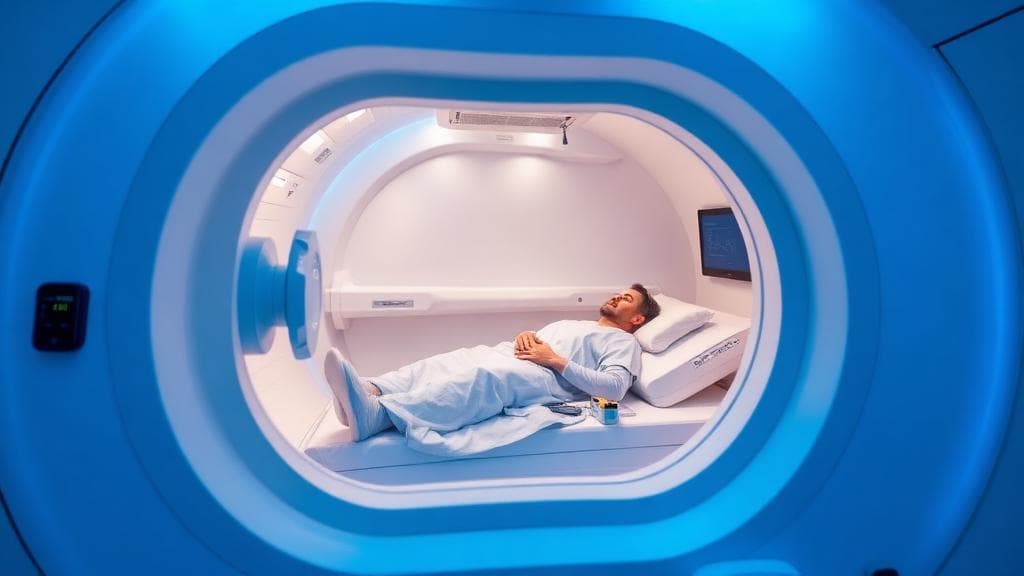
Hyperbaric Oxygen Therapy (HBOT) involves breathing nearly pure oxygen inside a pressurized chamber, allowing plasma—not just red blood cells—to carry substantially more oxygen to tissues. This temporarily hyperoxygenated state supports healing where normal circulation is impaired, reduces inflammation, and promotes cellular repair mechanisms that depend on adequate oxygen gradients. It is, in essence, an engineered dive response—using atmospheric pressure as medicine.
How HBOT Works
At sea level, oxygen saturation in blood is near 97–100%, but oxygen dissolved in plasma remains low. When chamber pressure increases to 1.5–3.0 ATA (atmospheres absolute), plasma oxygen can rise twentyfold, flooding even hypoperfused tissues. This enables oxygen diffusion into areas beyond blocked capillaries or swollen tissue beds. The physiologic effects include angiogenesis (new capillary formation), fibroblast activation, stem-cell mobilization, and modulation of cytokines involved in inflammation and oxidative stress. The therapy also exerts an antimicrobial effect by enhancing leukocyte function and creating oxidative conditions unfavorable for anaerobic bacteria.
Clinical Applications
HBOT is recognized by the Undersea and Hyperbaric Medical Society (UHMS) for 14 approved indications, including decompression sickness, carbon monoxide poisoning, radiation tissue injury, chronic refractory osteomyelitis, compromised grafts and flaps, and diabetic foot ulcers. In regenerative and longevity medicine, HBOT is increasingly explored for traumatic brain injury, neurocognitive decline, stroke recovery, post-concussion syndrome, and metabolic optimization. Emerging studies suggest roles in mitochondrial biogenesis, telomere elongation, and neuroplasticity—though these are still in early evidence stages.
Session Protocol and Experience
A typical HBOT session lasts 60–120 minutes. Patients either sit or recline in a monoplace or multiplace chamber while pressure gradually increases, simulating a descent of 15–45 feet underwater. Ears may pop during compression and decompression phases. Most individuals complete 20–40 sessions in a cycle depending on indication. Adjunctive monitoring includes vital signs, glucose checks (for diabetics), and periodic ear examinations. The experience is noninvasive and usually well tolerated, often described as “a meditative pressure nap.”
Safety, Contraindications, and Side Effects
HBOT is generally safe when performed under supervision by trained clinicians. Absolute contraindications include untreated pneumothorax and certain chemotherapy agents (bleomycin, doxorubicin). Relative contraindications include sinus or ear infections, seizure disorders, and severe claustrophobia. Temporary side effects may include ear barotrauma, mild fatigue, or transient vision changes due to lens oxygen exposure. These usually resolve after treatment completion. Proper chamber protocols and patient screening mitigate nearly all risk.
Integration with Longevity and Functional Care
For longevity clinics, HBOT is best positioned as a recovery and metabolic optimization tool rather than a standalone “anti-aging” intervention. The transient hyperoxic state followed by normoxic re-equilibration induces intermittent hypoxic-hyperoxic conditioning—a hormetic stress that can upregulate antioxidant defense systems (SOD, catalase), modulate inflammatory pathways (NF-κB, HIF-1α), and improve insulin sensitivity. Pairing HBOT with nutrition, exercise, red-light therapy, and sleep optimization amplifies the adaptive benefits across multiple systems.
Evidence and Research
Recent trials show promising outcomes in neurorehabilitation, such as improved cognitive scores in post-stroke and post-TBI patients following 40–60 sessions at 2.0 ATA. Studies from Israel’s Sagol Center for Hyperbaric Medicine have reported telomere lengthening and reduced senescent cell burden after repeated HBOT exposure. While these findings are groundbreaking, replication and larger cohort studies are ongoing. Clinicians should interpret early data with scientific caution and align patient expectations accordingly.
Practical Considerations
Facility standards matter. Accredited centers maintain continuous monitoring, redundant oxygen controls, and emergency decompression protocols. Patients should be briefed about avoiding petroleum-based products and flammable items during sessions. Documentation should include pressure level, duration, oxygen fraction, and total session count for reproducibility and continuity across care teams.
Common Misconceptions
“More pressure equals better results.” In reality, therapeutic effects plateau beyond 2.5 ATA for most soft-tissue uses and increase risk of oxygen toxicity.
“HBOT replaces rehabilitation.” It accelerates recovery potential, but functional gains depend on concurrent physical therapy, nutrition, and behavioral support.
“One session is enough.” Benefits are cumulative and dose-dependent; consistent scheduling over weeks is key.
Summary
HBOT is precision oxygen dosing under pressure—a tool that turns the most fundamental molecule in biology into a targeted regenerative signal. In capable hands, it bridges acute care, rehabilitation, and longevity science through one unifying principle: oxygen is information.
Benefits
Enhanced oxygen delivery to hypoxic tissues
Adjunctive support for wound healing and recovery
Investigated for brain injury, stroke, and cognitive support (evidence still limited)
Marketed for anti-aging, inflammation reduction, and athletic recovery
The Procedure
1
Consult & Screening
2
Chamber Entry
3
Pressurization
4
Oxygen Breathing
5
Decompression & Exit
Preparation
Avoid alcohol, smoking, and caffeine; eat a light meal; remove jewelry and avoid petroleum-based products; disclose sinus, ear, or lung conditions.
Recovery & Aftercare
Most resume activities right away. Temporary ear fullness, fatigue, or mild headache may occur; rare cases report lightheadedness after sessions.
Risks & Considerations
Risks include ear or sinus barotrauma, temporary vision changes, oxygen toxicity (rare at clinical protocols), claustrophobia, lung barotrauma, and seizures (rare). Contraindicated in untreated pneumothorax.
Frequently Asked Questions
References
[1]
Undersea and Hyperbaric Medical Society (UHMS). Indications for Hyperbaric Oxygen Therapy (2023).
https://www.uhms.org/resources/hbo-indications.html[2]
Heyboer M. et al. Mechanisms of Action for Hyperbaric Oxygen Therapy: Physiology and Applications (Undersea Hyperb Med, 2017).
https://pubmed.ncbi.nlm.nih.gov/28938258/[3]
Hadanny A., Efrati S. The Hyperoxic–Hypoxic Paradox: A Physiological Basis for Hyperbaric Oxygen Therapy (Medical Hypotheses, 2020).
https://doi.org/10.1016/j.mehy.2020.109773[4]
Shai E. et al. Hyperbaric Oxygen Therapy Induces Cognitive Enhancement and Telomere Lengthening in Aging Adults (Aging, 2020).
https://doi.org/10.18632/aging.202545[5]
Thom S.R. Oxidative Stress and Antioxidant Defense Mechanisms in Hyperbaric Oxygen Therapy (J Appl Physiol, 2009).
https://doi.org/10.1152/japplphysiol.91004.2008 Your Privacy Choices